
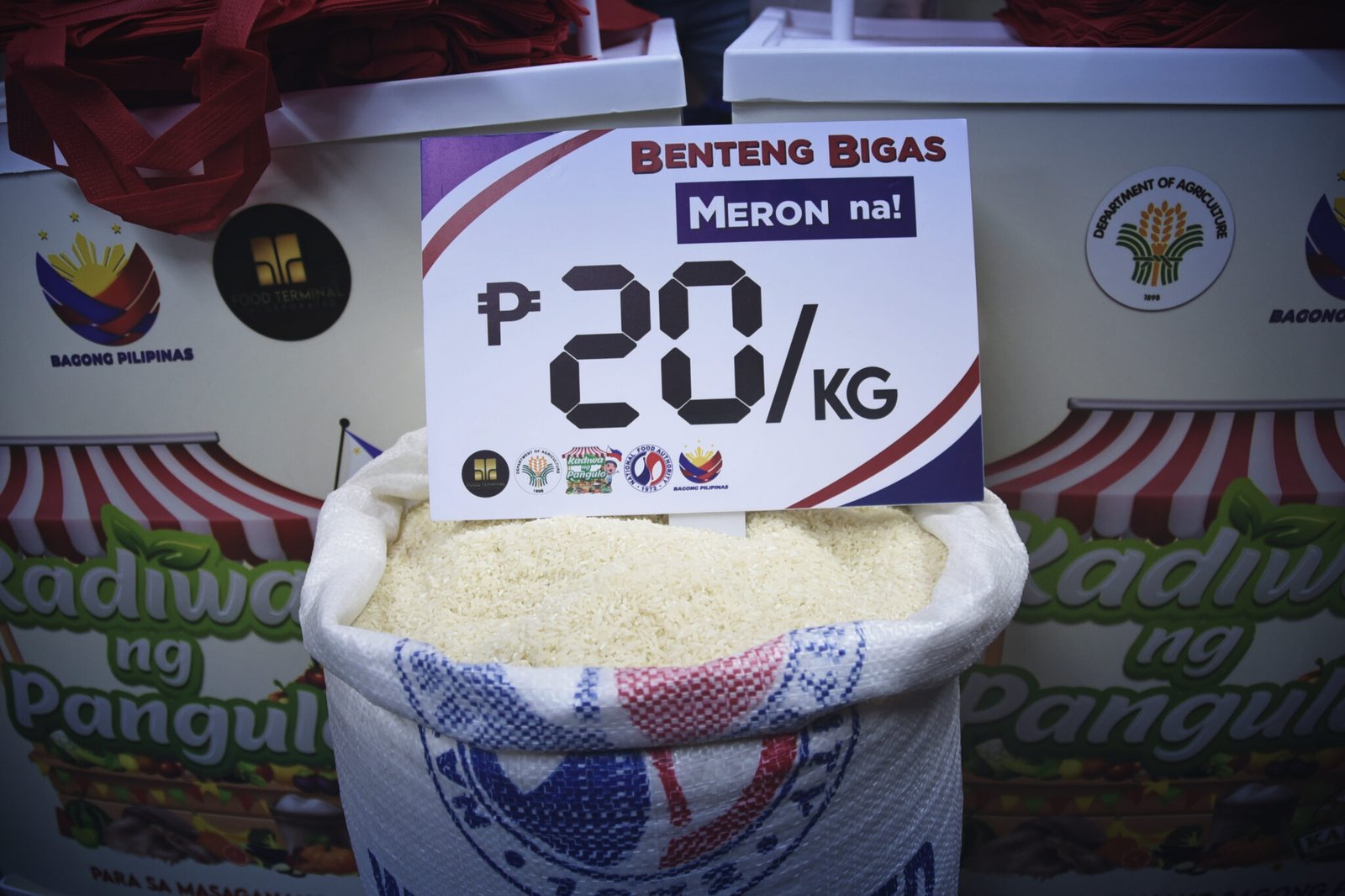
DA has established 932 P20 rice selling sites nationwide
Philippines Department of Agriculture (DA) is accelerating the nationwide rollout of President Ferdinand Marcos Jr.’s flagship food program, “Benteng Bigas, Meron Na!”, as the government moves to temper the impact on vulnerable households of rising costs driven by the ongoing energy emergency.
President Marcos has directed the DA to scale up the initiative—which offers rice at P20 per kilo—by extending selling hours and opening more distribution outlets across the country, broadening access at a time when higher fuel costs continue to feed into food prices.
Agriculture Secretary Francisco P. Tiu Laurel Jr. said the expansion is designed to steady food access as transport and logistics expenses push retail prices upward. As of the first quarter of 2026, the DA has established 932 P20 rice selling sites nationwide, composed of KADIWA outlets, National Food Authority (NFA) warehouses, local government units, national government agencies, and other sellers accredited by Food Terminal Inc. (FTI). As of April 7, 2026, a total of 6.45 million beneficiaries have been serviced across all operating sites.
Eligible beneficiaries include senior citizens, Pantawid Pamilyang Pilipino Program (4Ps) households, solo parents, persons with disabilities, and farmers and fisherfolk among others.
“We have sufficient food supply, but elevated fuel and logistics costs are pushing market prices to levels that further contain the budgets of many Filipinos,” Tiu Laurel said. “By expanding access to affordable rice and essential goods, we are directly easing that pressure and ensuring vulnerable sectors are protected while we work to stabilize both prices and supply.”
A major boost to the program comes from a newly formalized agreement between FTI and the NFA, securing funding and supply commitments for 2026. Building on this renewed FTI–NFA agreement, the DA is set to roll out an additional 900 P20 selling sites nationwide, prioritizing Capiz, Bukidnon, Cebu, Cotabato, Catanduanes and other high-need areas to further expand access to affordable rice for vulnerable communities.
The deal covers the procurement of about 1.8 million 50-kilogram sacks of well-milled rice, backed by a 3 billion budget, which is part of the ₱10 billion rice for all program. The initial 3B allocated to the NFA will scale up palay procurement—directly linking affordable rice distribution with stronger support for local farmers.
As rice stocks are released into the market, revenues are reinvested into further palay purchases, creating a continuous procurement cycle. This steady turnover also frees up space in NFA warehouses, enabling the agency to buy more from farmers, particularly during peak harvest periods when prices are most vulnerable.
“We assure that this budget will be used to secure better prices for our farmers, especially during the harvest season. In some areas, we have already increased our buying price to as much as ₱30 per kilo to prevent a drop in farmgate palay prices,” said NFA Administrator Larry R. Lacson. “The NFA continues to step in to protect the income of our farmers,” he added.
FTI, led by President and CEO Joseph Rudolph C. Lo, will serve as procuring entity, while the NFA will supply rice stocks under a negotiated agency-to-agency framework designed to speed up implementation.
“Given the current instability in market prices due to external conflicts, we are seeing a significant increase in buyers turning to our outlets to access quality rice at lower cost,” said Lo. “We are closely coordinating with government partners to manage this demand and are preparing to expand our network further, with a target of reaching 1,800 P20 rice selling sites nationwide by the end of 2026,” he added
The targeted market intervention is viewed as warranted, especially during this time of global oil is shock. The NFA’s mandate to maintain a buffer stock supports supply resilience, particularly during disruptions, while FTI’s distribution network is expected to improve last-mile delivery.
