
Export codes issued for key crops including mango and durian for EU and China markets
Khánh Hòa Province is accelerating its transition toward high-tech, climate-resilient agriculture as part of a broader strategy to enhance productivity, improve product quality, and expand export opportunities. Through the adoption of advanced farming systems, digital technologies, and stronger market linkages, the province is steadily reshaping its agricultural landscape into a modern, sustainable sector.
Situated in Vietnam’s south-central coastal and Central Highlands regions, Khánh Hòa has long faced challenges due to its dry and hot climate. However, these natural conditions are increasingly being transformed into an advantage through innovation and technology-driven farming practices.
Farmers, cooperatives, and agribusinesses across the province are investing in greenhouses, net houses, drip irrigation systems, and sensor-based monitoring technologies to better control temperature and humidity. These advancements are helping optimize growing conditions while improving efficiency and resilience against climate variability.
The adoption of VietGAP and GlobalGAP standards is also expanding, supporting higher product quality and enabling greater access to domestic and international markets. Key crops such as grapes, jujubes, asparagus, and honeydew melons have benefited significantly from controlled cultivation systems, resulting in more stable yields and improved commercial value.
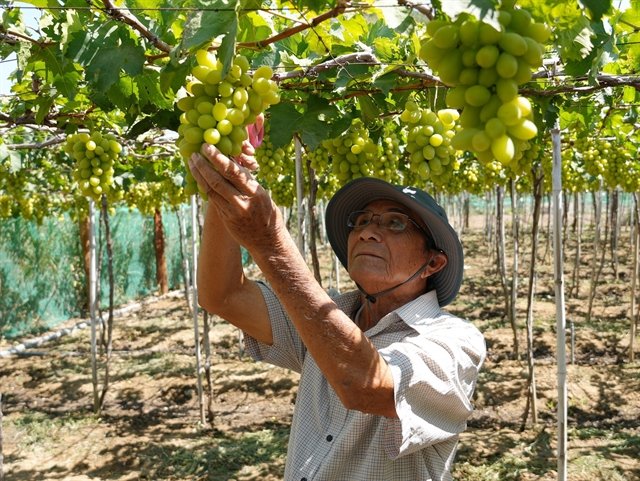
In several cases, high-tech agricultural models have delivered strong economic returns. Grape cultivation, for instance, generates profits of approximately VNĐ1–1.2 billion ($38,000–45,600) per hectare annually, while jujube farming yields between VNĐ160–267 million ($6,000–10,100) per hectare.
Local producer Nguyễn Văn Mọi, owner of the Ba Mọi grape farm in Ninh Phước Commune, highlighted the transformation underway in the sector, noting that his farm now cultivates 13 grape varieties, including both traditional and newly introduced types such as candy grapes and black finger grapes.
“Our grapes have entered supermarket systems, helping affirm product quality and build consumer trust in local produce,” he said.
The province has also expanded its certified organic farming area to nearly 5,600 hectares under international standards, including USDA Organic, Japanese Agricultural Standards, and EU certification. In addition, 170 growing area codes covering more than 3,540 hectares have been issued, alongside export-approved packing facilities for mango and durian targeting EU and Chinese markets.
Beyond production upgrades, Khánh Hòa is strengthening collaboration with research institutes, universities, and enterprises to accelerate technology transfer in crop varieties, post-harvest processing, and sustainable cultivation techniques. Integrated models such as water-saving irrigation, biological pest control, and intercropping systems are increasingly being adopted to enhance soil health and production efficiency.
Provincial leaders emphasized that high-tech agriculture plays a central role in both economic development and environmental sustainability.
Trịnh Minh Hoàng, Deputy Chairman of the Khánh Hòa Provincial People’s Committee, said the province is prioritizing agricultural restructuring through innovation, digitalization, and value-chain integration.
“High-tech agriculture not only brings economic benefits but also supports sustainable production and climate adaptation,” he noted.
Looking ahead to the 2026–2030 period, the province plans to expand concentrated farming zones, promote processing-linked production, and develop agricultural tourism to further increase value addition. Digital transformation will remain a core focus, particularly in traceability systems, production planning, and market connectivity.
In parallel, Khánh Hòa is actively promoting e-commerce adoption among farmers, particularly in mountainous areas such as Khánh Sơn and Khánh Vĩnh. Agricultural products including rice, dried bamboo shoots, durian, and grapefruits are increasingly being sold through digital platforms such as Facebook and Zalo, improving market access and household incomes.
Officials said digital tools are enabling farmers not only to expand sales channels but also to better understand consumer demand, allowing more responsive and market-oriented production decisions.
As Khánh Hòa continues to integrate technology, sustainability, and market expansion into its agricultural strategy, the province is positioning itself as a model for modernized, export-driven farming in Vietnam.
