
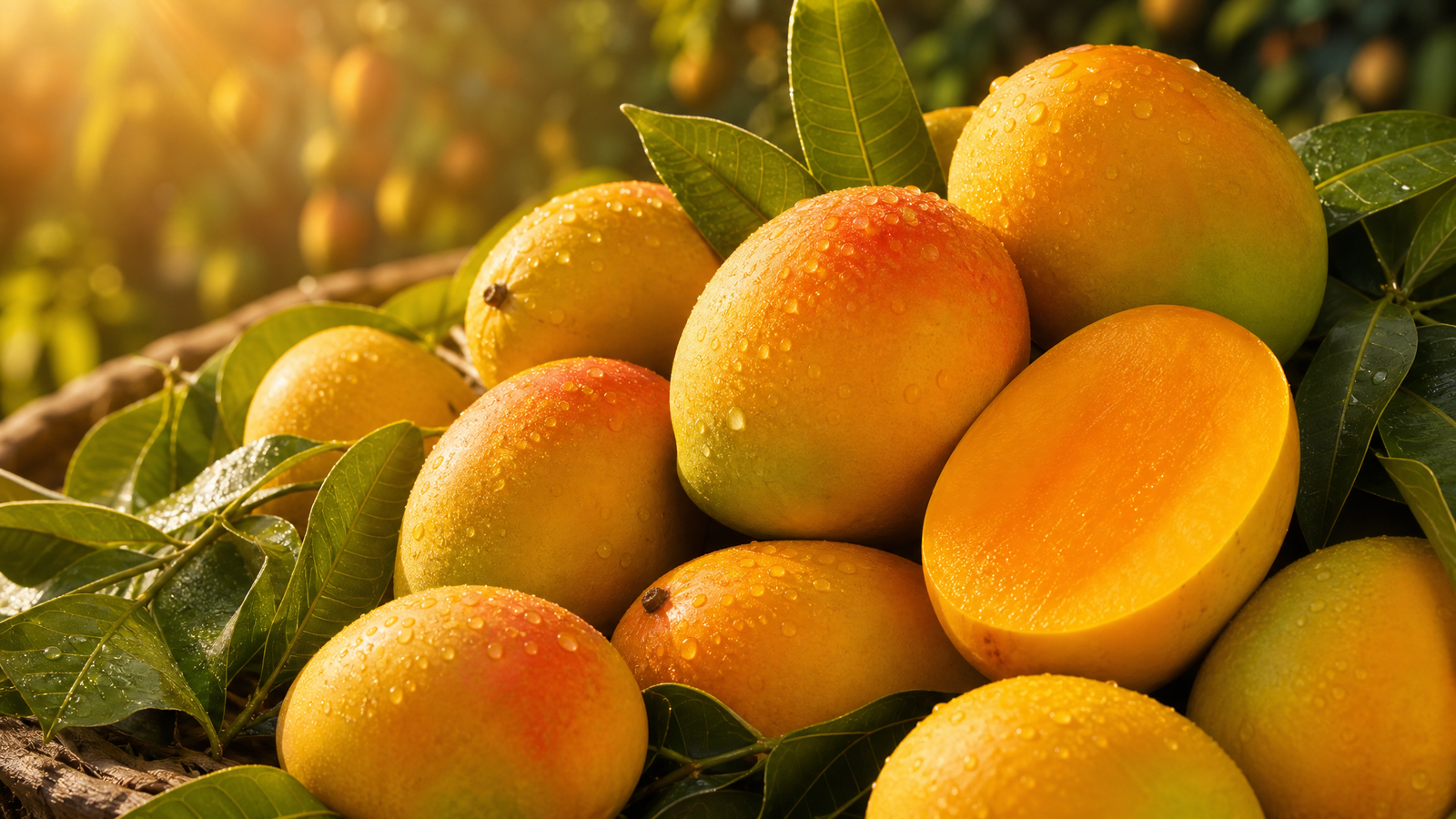
Erratic monsoon extension, sudden cold waves, and collapsing flowering cycles push Maharashtra’s iconic Alphonso belt into an unprecedented agrarian crisis
The Alphonso landscape of Konkan—spanning Ratnagiri, Devgad, and the adjoining coastal belt—has slipped into a season that growers struggle to recognise. What was once an annual choreography between soil, sky, and sea breeze now feels fractured, as though nature has misplaced its own timing. For decades, farmers here have lived by a quiet certainty: the monsoon would retreat, the land would dry into a soft stillness, and the mango trees would respond in synchronised bloom. That rhythm was not written in manuals but in memory, passed through seasons that rarely betrayed expectation.
This year, that memory has begun to blur. The rains did not leave when they were supposed to. Instead, they lingered deep into November, draping orchards in persistent moisture and blurring the transition from monsoon to winter. The land, instead of drying into its usual anticipation, remained suspended in humidity—unable to reset, unable to prepare.
When change finally arrived, it did so sharply. December did not arrive as a gentle winter but as an abrupt interruption. A sudden drop in temperature swept across the Konkan belt, arriving not as a gradual seasonal shift but as a climatic jolt. It came at the very moment orchards were meant to awaken into flowering.
The result has been a quiet failure in one of nature’s most delicate signals. Across groves, farmers describe trees that seem uncertain—branches thick with vegetative growth but hesitant to enter bloom, as though the biological instruction to flower never fully arrived. In some pockets, flowering is scattered and weak; in others, it is absent altogether, leaving orchards visually unchanged where they should have transformed. What is unfolding is not merely a reduction in yield. It is the breakdown of a rhythm that once defined the very identity of Alphonso cultivation in Konkan—a rhythm where climate, memory, and livelihood once moved in alignment, and now no longer do.
Flowering Collapse and the Breakdown of Yield Formation
In Alphonso cultivation, flowering is not just a stage in the crop cycle—it is the moment everything turns. It is where months of care, expenditure, and expectation quietly decide whether they will mature into income or dissolve into uncertainty. In Konkan’s orchards, this moment has always carried a sense of anticipation, as if the landscape itself pauses before revealing its annual promise.
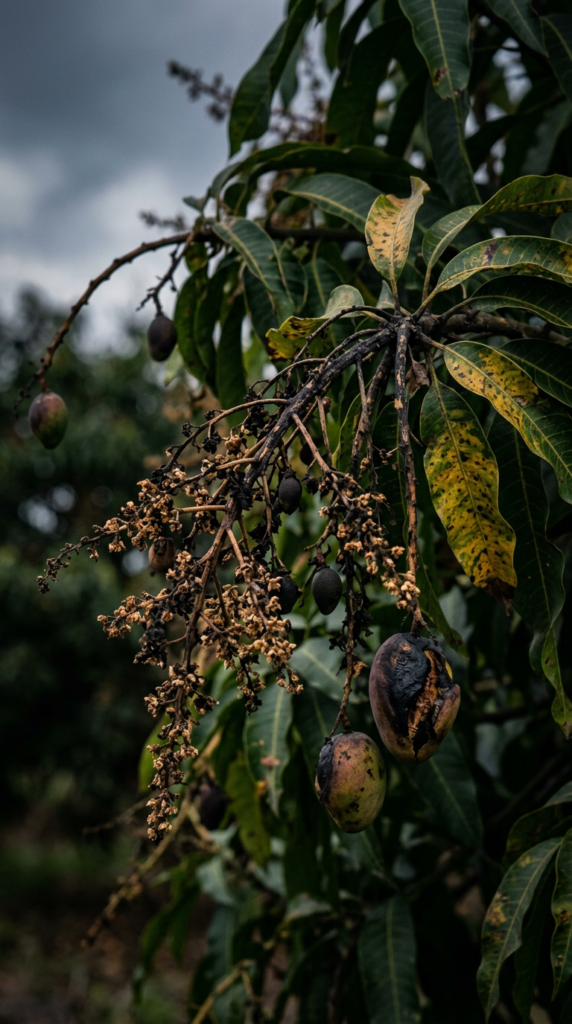
This year, that pause has stretched too long—and then failed to resolve. Across large stretches of the Konkan belt, flowering has emerged uneven, hesitant, and in many orchards, strikingly incomplete. What should have been a synchronized burst across thousands of trees has instead unfolded as scattered, irregular patches of bloom, with large sections of orchards remaining visually unchanged, as though the season never fully arrived.
Farmers describe a pattern that is difficult to reconcile with lived experience. In many holdings, only a small fraction of trees have entered productive flowering, while the majority have remained locked in vegetative growth. Even where flowering has occurred, it has often been weak, fragmented, and short-lived. Early field estimates suggest that only about 10 to 15 percent of expected flowering has translated into viable fruit set in several pockets. But even this limited formation has not held steady. In multiple orchards, young fruit has begun dropping prematurely, unable to withstand the lingering physiological stress carried over from the disrupted climatic cycle.
What is unfolding is not simply a reduction in yield. It is a visible imbalance in the tree’s internal energy distribution—where growth continues outward, but reproduction falters inward. The trees are alive, active, and green, yet unproductive in the very sense that defines their economic purpose. This shift signals something deeper than seasonal variability. It reflects a breakdown in yield formation itself, where the biological rhythm that governs flowering, fruit setting, and retention no longer aligns with environmental cues that once guided it so precisely.
For farmers, the implications are immediate and severe. A season that fails at flowering does not merely reduce harvests; it dismantles the entire economic architecture built around it. What remains is not just a smaller crop, but a disrupted system of expectation—one where planning, investment, and return no longer move in predictable sequence. In Konkan’s Alphonso belt, the orchard has not stopped growing. But it has stopped responding in the way it once did.
Income Collapse in a Monocrop Orchard Economy Under Climate Volatility
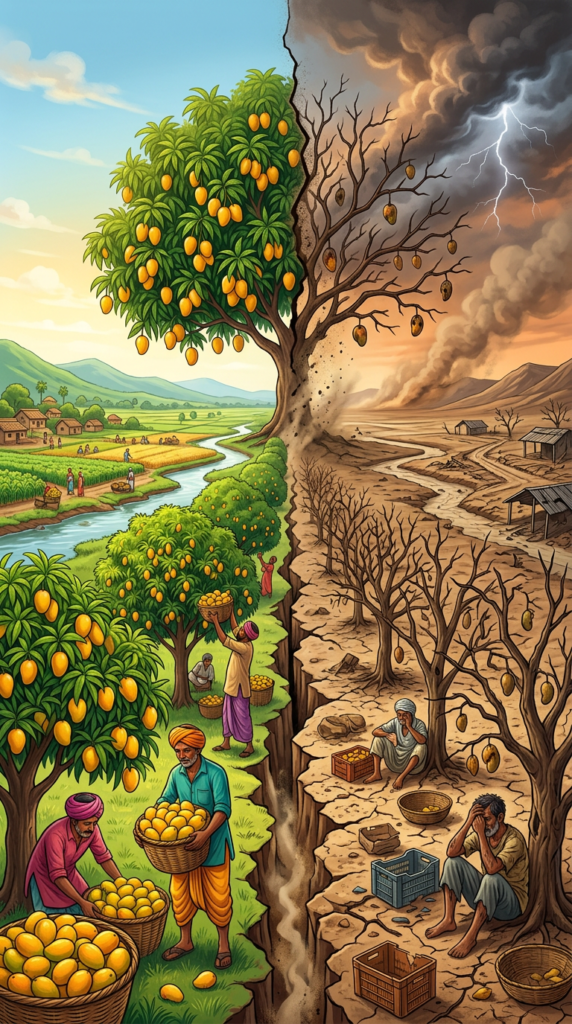
For Konkan’s mango growers, Alphonso is not merely a crop—it is the financial axis around which the entire year rotates. In this monocrop orchard economy, income is not distributed across seasons or diversified across produce. It is concentrated into a single, fragile harvest window that determines household stability, debt repayment capacity, reinvestment in orchards, and even basic consumption for months ahead.
When that window weakens, the impact is immediate and absolute. This year, that equilibrium has collapsed.
Farmers across the Konkan belt have already absorbed the full cost of the season long before harvest—labour for pruning and orchard upkeep, repeated applications of inputs, maintenance through the monsoon cycle, and the continuous care required by perennial orchards that do not allow seasonal switching or fallback crops. These investments are locked in early, with returns entirely dependent on successful flowering and fruit set. But the return cycle has not arrived.
With flowering severely disrupted and fruit formation remaining minimal, the gap between expenditure and realisation has widened into a financial rupture. What should have been a season of recovery has instead become a season of deferred collapse, where costs remain fixed but income evaporates.
The consequence is a liquidity shock that spreads quickly through rural households. Daily consumption planning becomes uncertain, repayment cycles tighten, and reinvestment into orchards for the next season becomes increasingly difficult. In a system with limited diversification, there are no internal buffers strong enough to absorb such a shock. What intensifies this crisis is not only the loss of output, but the climatic sequence that triggered it.
The extended monsoon period stretching into November prevented orchards from entering the dry post-monsoon phase essential for flowering initiation. Instead of the expected seasonal reset, orchards remained trapped in lingering moisture and high humidity, delaying the biological transition that governs reproductive growth. Just as the system struggled to stabilise, it was confronted by the opposite extreme.
December brought an abrupt and unseasonal cold spell, introducing thermal stress at a critical reproductive stage. This sudden shift disrupted flowering synchronisation, weakening fruit set and destabilising early development across orchards. Together, these back-to-back climatic deviations have dismantled the environmental sequencing that Alphonso cultivation depends on—first by delaying it, then by disrupting it entirely.
Farmers are increasingly reading this not as seasonal variability, but as a deeper structural change in climate behaviour itself. The familiar language of “bad season” is giving way to a more unsettling recognition: that the baseline itself is shifting. In this emerging reality, risk is no longer cyclical and recoverable within a season. It is becoming structural, cumulative, and increasingly unpredictable—turning what was once a stable orchard economy into one exposed to continuous climatic uncertainty.
Market Distortion Amid Production Scarcity

In a normal agricultural cycle, scarcity tends to sharpen value. When supply falls, prices rise, and the benefit of that imbalance typically flows—at least partially—back to the farmer. But this season in Konkan’s Alphonso economy, that basic equation is no longer holding true. Despite a sharp contraction in production, growers are not witnessing proportional gains at the farmgate. The expected price uplift, which should naturally accompany reduced availability, is being diluted by structural distortions in the market.
At the centre of this distortion is the question of identity.
Genuine Alphonso from Konkan—particularly from Ratnagiri and Devgad—has become increasingly difficult to isolate within the broader supply chain. As production tightens due to climate-induced flowering failure, mangoes from other regions are entering the market and being positioned under the same premium geographical labels. In a season where authentic supply is already constrained, this blending of origin has intensified competition not on quality alone, but on branding and perception.
The outcome is a market where geographical authenticity is steadily losing clarity. What was once a tightly defined identity linked to soil, climate, and place is now being stretched across multiple origins, weakening the distinction that once supported premium valuation.
For farmers, this creates a paradoxical outcome. Even as orchards produce less, the market does not reward scarcity in a straightforward way. Instead, value is redistributed through layers of aggregation and re-labelling, where origin becomes less visible and price discovery becomes less reflective of actual production conditions.
The erosion of this link has a deeper consequence. It weakens consumer trust in origin-based branding while simultaneously limiting the ability of genuine growers to command the premium historically associated with Konkan Alphonso. In effect, scarcity exists in the orchards, but it is not fully visible in the marketplace. And where it is not visible, it does not translate into proportional economic advantage for those who bear the cost of its creation.
Farmer Leadership Warns of Climate Shock Turning Into Income Collapse
Farmer leaders are increasingly framing the current crisis not as a routine seasonal aberration, but as a clear manifestation of climate-induced structural disruption in Konkan’s Alphonso economy.

According to Raju Shetti, former Member of Parliament and Founder President of Swabhimani Kisan Sanghatana, Maharashtra, the Alphonso belt is undergoing what he describes as an unprecedented climate shock. He notes that extended monsoon conditions stretching into November, followed by abnormal cold spells, have disrupted the natural flowering cycle in a manner never previously witnessed in the region. As a result, December flowering has largely failed, with only around 10 to 15 percent of expected fruit setting achieved in several orchards, further compounded by heavy post-harvest losses.
He further points to a parallel stress unfolding in the marketplace, where limited genuine Maharashtra Alphonso supply is being diluted through the entry of mangoes from other states sold under premium geographical labels such as Ratnagiri and Devgad Hapus. This, he argues, is eroding both price integrity and consumer trust at a moment when scarcity should have strengthened producer realisations.
In his assessment, the situation has moved beyond seasonal fluctuation into what he terms a direct conversion of climate risk into income collapse, necessitating immediate climate-linked subsidy support and targeted financial assistance for affected growers.

At the policy level, concerns are intensifying alongside agrarian distress. Ganesh Gavakar of the Swabhimani Shetkari Sanghatana has described the situation as an unprecedented crisis in Konkan’s Alphonso belt, marked by the absence of male flowering and near-total crop failure across orchards due to extreme climate disruption.
Gavakar has called for urgent intervention measures, including compensation of Rs 5,000 per tree—translating to nearly Rs 5 lakh per acre for an average plantation of 40 trees—along with a complete loan waiver across all 14 mango-growing districts of Maharashtra. He has also flagged the deepening dependence on informal credit channels, where farmers are being compelled to borrow at nearly 2 percent monthly interest from traders and moneylenders, intensifying financial vulnerability.
Alongside financial relief, Gavakar has demanded strict enforcement against market exploitation and stronger pricing regulation to ensure fair remuneration for growers. In his view, the crisis represents not a seasonal agricultural setback but a structural collapse driven jointly by climate stress and market distortions, requiring immediate and decisive state intervention.
A Season That Signals a Larger Agricultural Transition
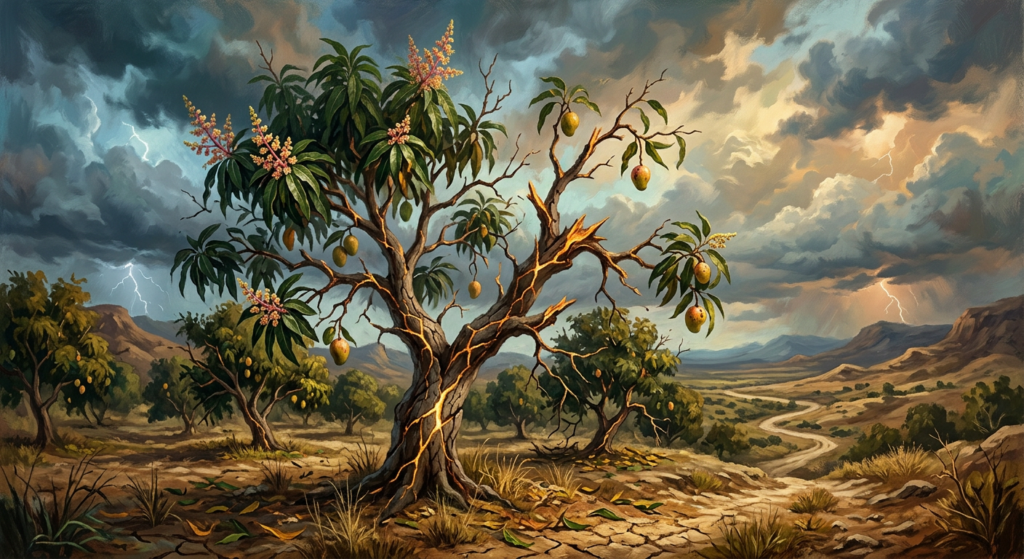
The crisis unfolding in Konkan’s Alphonso belt is no longer a contained agricultural setback confined to a single harvest cycle. It is increasingly being read as part of a broader transition in which climate variability is reshaping the very foundations of perennial horticulture systems.
What was once governed by predictable seasonal rhythm—monsoon withdrawal, winter stability, and a tightly sequenced flowering cycle—is now being disrupted by irregular climatic behaviour. Extended rainfall windows, abrupt temperature shifts, and inconsistent post-monsoon conditions are weakening the environmental cues that perennial crops depend upon for reproductive stability.
In this emerging reality, crops such as Alphonso mango, which rely on precise biological triggers for flowering and fruit set, are becoming structurally more vulnerable. The result is not just yield fluctuation, but a deeper uncertainty that now extends into agricultural planning, input investment decisions, market forecasting, and rural income stability. Konkan’s orchards, long regarded as a stable and premium horticultural ecosystem, now sit at the intersection of three converging pressures—climate stress, market distortion, and policy gaps. Together, these forces are steadily replacing traditional agricultural certainty with a more volatile and unpredictable production landscape.
Within this shifting frame, the Alphonso season itself is being redefined. Once marked by anticipation and rhythm, it is increasingly shaped by unpredictability—where the outcome of an entire year is no longer governed by established seasonal expectations, but by the growing instability of climate itself.
— Suchetana Choudhury (suchetana.choudhuri@agrospectrumindia.com)
