
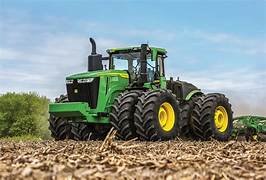
Strong execution across Small Ag and Construction & Forestry divisions offsets cyclical weakness, with full-year profit guidance maintained at $4.5–$5.0 billion
Deere & Company reported net income of $1.773 billion for the second quarter ended May 3, 2026, compared with $1.804 billion in the same period last year, reflecting a marginal decline amid continued volatility in global agricultural equipment markets.
Earnings per share stood at $6.55, slightly lower than $6.64 a year earlier. For the first six months of fiscal 2026, net income attributable to Deere was $2.429 billion, down from $2.673 billion in the prior-year period, or $8.97 per share versus $9.82 per share, underscoring softer conditions in parts of the global farm economy.
Revenue growth driven by diversified portfolio strength
Despite the earnings moderation, Deere delivered solid top-line expansion. Worldwide net sales and revenues rose 5 per cent year-on-year to $13.369 billion in Q2, while six-month revenues increased 8 per cent to $22.981 billion.
Net sales for the quarter rose to $11.778 billion, compared with $11.171 billion a year earlier, while six-month net sales increased to $19.779 billion from $17.980 billion, reflecting improved demand across multiple segments and geographies.
Segment strength led by Small Ag and Construction & Forestry
Management highlighted that performance was anchored by strong execution in Small Agriculture and Construction & Forestry divisions, which helped offset ongoing challenges in global agricultural markets.
Leadership emphasized that Deere’s diversified portfolio continues to support market share expansion, even as broader agricultural equipment demand remains uneven due to commodity price pressures and cautious farm investment cycles.
Management commentary underscores portfolio resilience
Chairman and CEO John May noted that performance in the current environment reflects the strength of Deere’s diversified business model, particularly the strong outcomes delivered by Small Ag and Construction & Forestry segments.
He added that despite persistent headwinds in global agricultural markets, the company’s portfolio continues to support sustained growth objectives and competitive positioning.
Deere maintained its fiscal 2026 net income outlook of $4.5 billion to $5.0 billion, signaling confidence in operational stability and demand resilience for the remainder of the year.
Management reiterated that the company remains focused on disciplined execution and supporting customer success through market cycles.
Investment in innovation and precision agriculture
The company emphasized continued investment in new products, technology, and precision agriculture solutions, aimed at strengthening long-term growth and value creation.
Deere highlighted its strategy of investing “through the cycle,” leveraging its dealer network strength and expanding its smart industrial capabilities to enhance customer productivity and equipment efficiency.
Forward-looking risk environment remains broad and complex
The outlook remains shaped by multiple structural and cyclical risks, including:
Agricultural business cycle volatility driven by farm income, commodity prices, crop yields, and input costs
Macroeconomic pressures such as inflation, interest rates, and energy price volatility
Trade uncertainty, tariffs, and geopolitical disruptions affecting global supply chains
Climate variability and extreme weather impacting agricultural output
Raw material availability and pricing fluctuations
Supply chain disruptions and manufacturing constraints
Regulatory changes across environmental, trade, labor, and data governance frameworks
Cybersecurity risks and increasing reliance on digital and AI-enabled systems
Litigation and regulatory scrutiny, including ongoing legal challenges related to equipment repair rights
The company also cited broader risks related to climate change policies, workforce dynamics, and evolving competitive pressures in precision agriculture and smart industrial technologies.
