
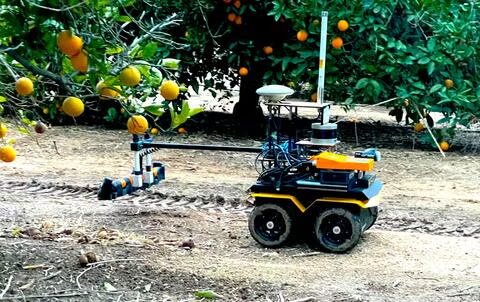
New tree-by-tree soil moisture technology combines robotics, sensors, and data analytics to help growers optimize irrigation, conserve water, and improve crop productivity amid mounting drought pressures
As water scarcity intensifies across major agricultural regions, researchers at the University of California, Riverside (UCR) have developed an advanced precision irrigation system capable of mapping soil moisture on a tree-by-tree basis, offering growers a powerful new tool to reduce water waste while sustaining productivity.
The technology, detailed in the journal Computers and Electronics in Agriculture, represents a significant step forward in precision agriculture by enabling farmers to identify exactly where irrigation is needed across an orchard rather than relying on limited data from a handful of buried moisture sensors.
Led by Dr. Elia Scudiero, Associate Professor of Precision Agriculture and Director of UCR’s Center for Agriculture, Food, and the Environment (CAFE), the project addresses one of the most pressing challenges confronting modern agriculture: managing water resources efficiently in an era of prolonged droughts, rising irrigation costs, and increasing groundwater restrictions.
“Current soil moisture sensors provide only a very localized view of field conditions,” Scudiero explained. “Growers often have to extrapolate that information across hundreds or even thousands of trees, despite significant variations in soil characteristics within the same orchard.”
Those variations can be substantial. Differences in soil texture, clay content, salinity, and drainage patterns often result in neighboring trees experiencing dramatically different moisture conditions, even when irrigation systems distribute water uniformly across the field.
To overcome this limitation, the UCR team developed a robotic system capable of traversing orchards while measuring soil electrical conductivity, a property influenced by moisture, salinity, and soil composition. By integrating these conductivity measurements with data from strategically placed soil moisture sensors, researchers created a predictive statistical model capable of estimating water availability throughout the entire orchard.
The outcome is a highly detailed moisture map that reveals water distribution at the individual tree level, allowing growers to target irrigation with unprecedented precision.
“Using this system, farmers can understand not only how much water is available across their fields, but also where specific trees may be experiencing water stress,” Scudiero said. “That enables more informed irrigation decisions and helps ensure water is applied only where it is truly needed.”
The implications extend beyond water conservation. Maintaining optimal soil moisture is critical to tree health and productivity. Insufficient water can weaken crops and increase vulnerability to pests and diseases, while excessive irrigation can deprive roots of oxygen, impairing growth and reducing yields.
“There is a balance growers need to achieve,” Scudiero noted. “Too little water creates stress, but too much can be equally damaging.”
The technology could also help address mounting economic and environmental pressures facing growers. Across California and other water-stressed agricultural regions, farmers are grappling with tighter groundwater regulations and escalating water costs. Precision irrigation offers a pathway to maintain production while reducing overall water consumption.
“If water becomes increasingly scarce, producers are often left with difficult choices,” Scudiero said. “They can reduce cultivated acreage, or they can adopt technologies that allow them to grow the same crops with less water.”
Beyond irrigation efficiency, the system may also contribute to improved environmental outcomes. Overwatering can cause fertilizers and nutrients to leach beyond the root zone and contaminate groundwater supplies. By matching irrigation more closely to crop requirements, growers can reduce nutrient losses and improve fertilizer-use efficiency.
The project represents the culmination of several years of interdisciplinary collaboration between agricultural scientists and engineers at CAFE. Research began in 2019 with the goal of integrating advanced soil sensing technologies with autonomous field robotics.
For Scudiero, the development fulfills a long-held vision. Having spent more than a decade studying soil electrical conductivity and its agricultural applications, he saw autonomous field surveying as the next logical step in transforming how growers manage water resources.
The research team has already filed a patent covering aspects of the robotic system, including a novel method that enables interaction with in-field sensors without disrupting their measurements. Initial testing was conducted at the UCR Citrus Research Center and Agricultural Experiment Station.
Looking ahead, researchers plan to expand testing beyond university research orchards and evaluate the system under commercial farming conditions. Future development will focus on creating more rugged autonomous platforms capable of operating across diverse crops, terrains, and weather conditions. Industry partnerships are also expected to play a role in bringing the technology to market.
The initiative forms part of a broader effort at UCR to advance precision agriculture through the integration of robotics, sensor technologies, and data science. As climate pressures continue to reshape agricultural production, researchers believe such innovations will become increasingly essential for sustaining food production while preserving critical natural resources.
For growers facing uncertain water supplies, the promise is straightforward: higher efficiency, lower waste, and greater resilience.
As Scudiero succinctly puts it: “More crop per drop.”
