
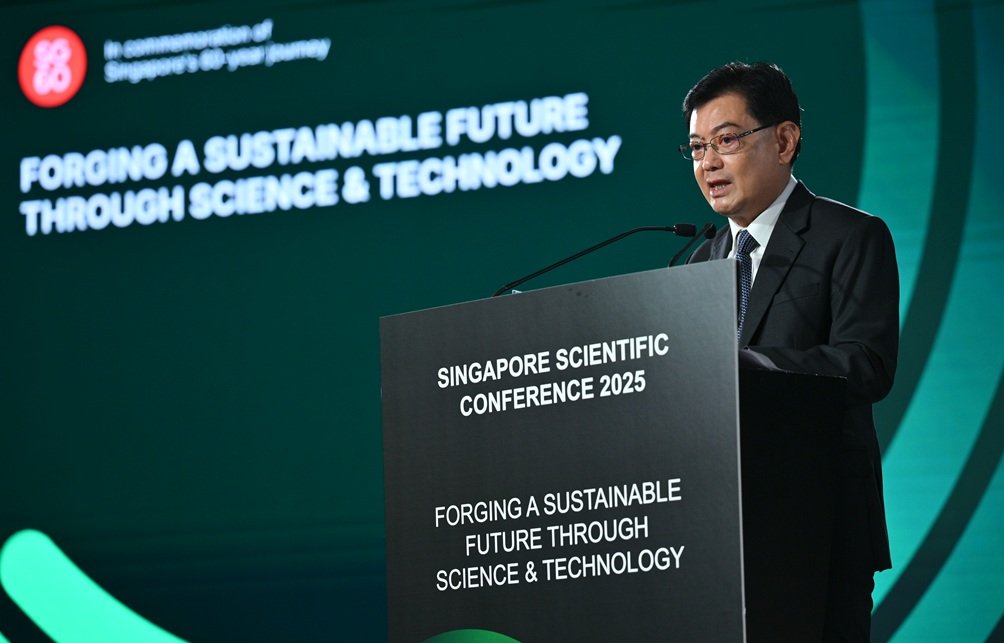
Forging a “Sustainable Future Through Science & Technology” : identifies five priority areas “decarbonization; climate change adaptation; land resilience; sustainable urban development; and innovation translation”
Singapore places a strong focus on sustainability, under its Research, Innovation and Enterprise 2030 or RIE2030, a five-year plan to strengthen Singapore’s national research and innovation ecosystem. The Government has allocated $37 billion for RIEC 2030. Sustainability research in RIE2030 leverages resources and capabilities across the ecosystem, extending beyond individual domains to drive innovative, collaborative solutions for a sustainable future.
At the Singapore Scientific Conference 2025 on December 8, perspectives from diverse disciplines and regions were united under the theme “A Sustainable Future Through Science and Technology”. The RIE2030 plan emphasizes funding research and innovation to advance national and economic priorities, enhance AI, data, and computational capabilities, and strengthen the talent pool and basic research.
Heng Swee Keat, Chairman of the National Research Foundation, graced the Singapore Scientific Conference 2025 and, in his opening remarks, he underscored that, as science, technology, and innovation continue to advance, sustainability becomes crucial.
Forging a “Sustainable Future Through Science & Technology”
Climate change is no longer a distant threat, but a clear existential issue for a low lying island nation. It is also a threat to the entire planet, as ecosystems and biospheres are so deeply integrated. The chairman encouraged collaborative approaches towards adapting, innovating, and sharing solutions for a sustainable future for all.
A major domain of RIE2030 plan is to tackle Urban Solutions and Sustainability – how a city can find innovative solutions to our land and carbon constraint. To tackle the challenges, Singapore has identified five priority areas: decarbonization; climate change adaptation; land resilience; sustainable urban development; and innovation translation.
“For instance, our coastal protection research programme is developing cutting-edge solutions to safeguard Singapore against rising sea levels – from nature-based solutions that harness mangroves and coastal ecosystems, to advanced engineering approaches that can withstand the forces of climate change. We have announced a plan to build a Long Island, off the East Coast of Singapore” said Heng Swee Keat.
The global energy transition is one of the most critical issues in tackling climate change and in enabling countries to meet the growing energy demands, which is rising sharply as companies invest in AI and data centres. Singapore is actively exploring with partners in the region, to source for renewable sources of energy. In addition, established the Nuclear Research and Safety Institute, to build a deeper understanding of nuclear technologies and safety requirements, as countries around the world build nuclear facilities to meet their needs.
AI is being deployed to tackle sustainability challenges, from optimising energy systems and predicting climate impacts to enhancing resource efficiency across our economy.
In the Manufacturing, Trade and Connectivity domain, market trends are emerging for sustainable products and early signs of a more mature industrial system developing globally. Following this, Singapore is advancing its capabilities in the bioeconomy, leveraging energy, chemicals, and biotechnology to create new high-value industrial activities anchored in the energy and chemicals sectors which will be transformed.
Singapore is also investing in alternative feedstocks and bioprocess development – areas that hold strong promise for transforming our approach to manufacturing and resource utilisation.
“By developing technologies that can convert waste streams, agricultural residues, and other non-traditional materials into valuable products through advanced bioprocessing, we can reduce our dependence on conventional raw materials, minimize waste, and create new circular economy opportunities. These capabilities will be essential as the world transitions towards more sustainable production systems.” explains the Chairman.
“While our research ecosystem is small compared to those of major economies, it can be highly effective if we break down silos – across disciplines, across industries. The best innovation comes at the intersection of different disciplines and stakeholders. So, we seek to bring together the best minds from around the world, promote a collaborative spirit, and create solutions that benefit Singapore and the world. “ added Heng Swee Keat.
