
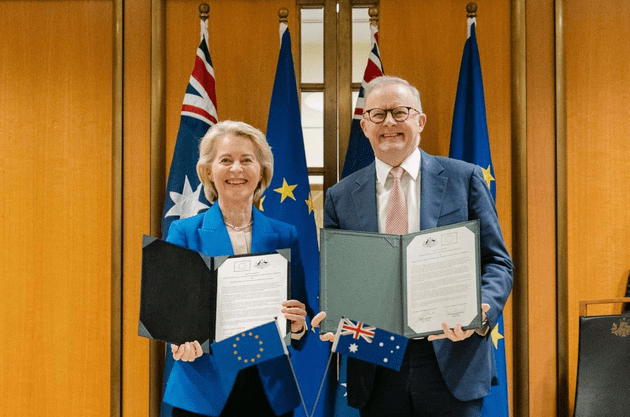
The free trade agreement ends eight years of bilateral negotiations
Australia and the EU have strengthened their partnership by finalizing negotiations for a balanced free trade deal. A formal discussion initiated to associate Australia with Horizon Europe, the world’s largest research and innovation funding program, reinforcing their close ties in a period of geopolitical uncertainty.
Canberra between European Commission President Ursula von der Leyen and Prime Minister of Australia Anthony Albanese represented the formal agreement signing ceremony. The free trade agreement (FTA) after eight years of negotiations, marking a significant milestone in bilateral trade relations.
The EU has a positive trade balance for agri-food products with Australia, worth €2.3 billion in 2024. The agreement will eliminate tariffs on major EU exports such as cheeses, meat preparations, wine and sparkling wine, some fruits and vegetables including preparations, chocolate, and sugar confectionary.
The agreement takes into account the interests of EU agricultural producers. For sensitive agricultural sectors such as livestock, sugar, some dairy products and rice, the agreement will allow zero or lower tariff imports from Australia only in limited amounts, through carefully calibrated Tariff Rate Quotas.
In addition, the agreement includes a bilateral safeguard mechanism allowing the EU to take measures to protect sensitive European products and their producers in the unlikely event of a surge in imports from Australia causing injury to the EU market. As an additional layer of protection for farmers, the bilateral safeguard mechanism will be operationalised in a self-standing EU regulation that will see swift and effective protections kick into gear, in the unlikely event of an unforeseen and harmful surge in imports or an undue decrease in prices for EU producers.
Moreover, the Agreement will protect 165 agricultural and food Geographical Indications (‘GIs’) and 231 spirit drink GIs including some of the most renowned ones such as Comté, Irish Whiskey, Queso Manchego, Salam de Sibiu, Istarski pršut ham, Lübecker Marzipan and Masticha Chiou.
The EU and Australia have also agreed on a modernised bilateral wine agreement, updating the full list of EU wine GIs and traditional terms protected in Australia. Building on the previous successful agreement, it will offer protection for all EU wine GIs (representing 1,650 names), including the addition of 50 new wine GIs from 12 different Member States.
Response from the farmers community
The EU has long been a key market for Australian canola, purchasing 3.65 million tonnes of canola seed in the year to September 2025 out of total exports of 5.4 million tonnes. The FTA will set the tariff on Australian canola oil to zero, down from 5.1-9.6 %, benefiting the biodiesel market and creating value for Australian growers. However, farm bodies have expressed disappointment, arguing the deal offers limited agricultural market access gains and questioning the EU’s potential use of subsidies to support its producers.
Critics, including the National Farmers Federation and Victorian Farmers Federation, contend that the FTA fails to address the challenges Australian farmers face, such as global trade headwinds from conflicts, tariffs, and rising costs. They argue that no deal would have been preferable to the current terms, which they see as offering subpar access for key agricultural commodities. Despite these concerns, the FTA is set to remove most Australian tariffs on EU imports, including wine, spirits, and machinery, while also providing Australian exporters with duty-free access for 98 % of the current value of their exports to the EU. The agreement also clarifies geographical indicators, preserving Australian winemakers’ rights to produce and sell Prosecco domestically and allowing phased-out use of certain terms like Feta and Gruyere.
Economic Impact:
Beyond agriculture, the FTA is expected to enhance trade and investment between Australia and the EU, the world’s second-largest economy. It will improve access for Australian service providers in sectors like financial services, education, and tourism, while also streamlining professional mobility and qualifications recognition.
The deal supports Australia’s ambition to become a renewable energy superpower by eliminating EU tariffs on critical minerals and hydrogen. Additionally, Australian businesses will gain better access to lucrative EU government contracts, valued at approximately $845 billion annually. Prime Minister Anthony Albanese and Trade Minister Don Farrell have hailed the agreement as a strategically important step that will deliver long-term benefits for both parties, despite the challenges and criticisms raised by some sectors.
By Hithaishi Bhaskar
