
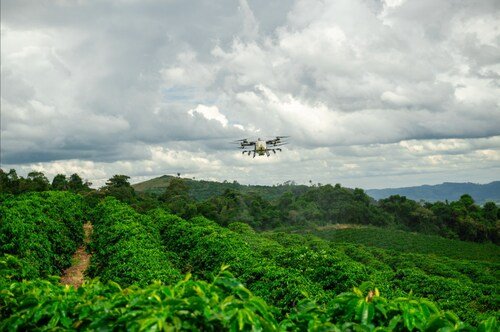
New industry report says more than 600,000 agricultural drones are now operating across 100 countries, helping reduce carbon emissions and improve precision farming practices
DJI Agriculture has said the growing global adoption of agricultural drones has helped farmers save an estimated 410 million tons of water and reduce carbon emissions by 51 million tons, according to its latest Agricultural Drone Industry Insight Report for 2025–26.
The report was unveiled at Agrishow 2026 in Ribeirão Preto, Brazil, and highlights the rapid expansion of drone-based precision agriculture worldwide. According to the company, more than 600,000 DJI agricultural drones are now in operation across over 100 countries and regions, supported by a global network of more than 600,000 trained operators.
DJI said the estimated water savings are equivalent to the annual drinking water consumption of approximately 740 million people, while the carbon reductions match the annual carbon absorption capacity of around 240 million trees.
The company said agricultural drones are increasingly becoming mainstream farm equipment as growers adopt precision spraying, seeding, and crop management technologies to improve productivity and reduce environmental impact.
Brazil Emerging as Major Drone Agriculture Market
DJI highlighted Brazil as one of its fastest-growing agricultural drone markets, with drones now widely used across major crops including soybeans, corn, coffee, sugarcane, and forage grass.
According to the report, Brazilian farmers are using DJI Agras drone models for full-cycle forage management operations, including spraying and seeding activities aimed at improving pasture productivity and operational efficiency. The company said precision spot-spraying through drones can reduce herbicide use by up to 35 per cent, while also lowering soil compaction, minimizing chemical drift, and reducing the carbon footprint of livestock farming operations.
Precision Agriculture Gains Regulatory Support
The report also noted increasing regulatory support for agricultural drone adoption across several countries.
In Brazil, the National Civil Aviation Agency (ANAC) has updated drone regulations to establish standard operating scenarios for recurring agricultural activities. Canada has also simplified operational rules for agricultural drones through amendments to aviation regulations aimed at supporting precision farming applications including spraying, monitoring, and mapping.
DJI said growing academic research and field trials are strengthening evidence around the operational efficiency, sustainability, and precision benefits of agricultural spraying drones. The report highlighted updated field-drift studies and pesticide application guidelines developed by organizations such as UAPASTF to improve safe and compliant drone operations in agriculture.
Industry Expansion Supported by Training Network
DJI Agriculture said it has expanded its global support infrastructure with approximately 3,500 service and repair centers and more than 7,000 certified drone instructors worldwide.
The company said continued investment in operator training and standardization is helping accelerate adoption of agricultural drones across global farming systems. Industry analysts say agricultural drones are becoming increasingly important as farmers seek technologies that improve resource efficiency, reduce chemical use, and support climate-resilient farming practices.
The report said drone adoption is expected to continue expanding as governments, agribusinesses, and growers increasingly integrate precision agriculture technologies into mainstream farming operations.
