
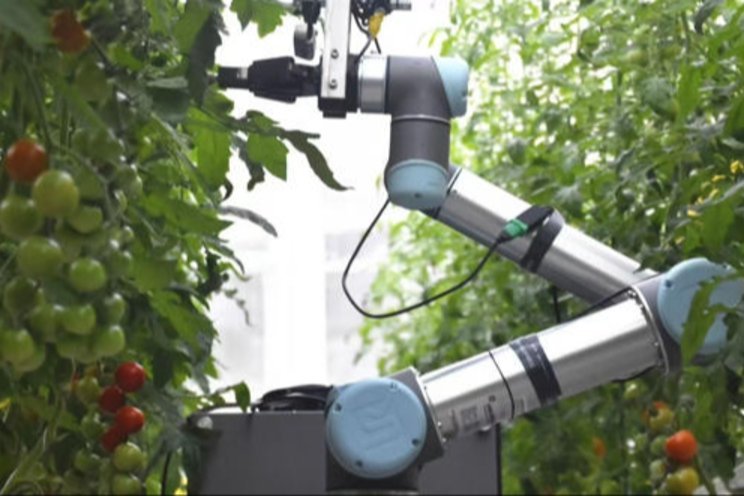
Chinese Academy of Sciences deploys AI-driven systems to replace manual hybrid breeding processes with precision robotics
China’s agricultural sector is undergoing a rapid structural transformation, with science and technology now contributing more than 64 percent to agricultural output growth, underscoring a decisive shift away from labour-intensive practices toward a modern, innovation-led production system. Improved crop variety coverage has surpassed 96 percent, while the comprehensive mechanisation rate for crop cultivation and harvesting has reached 76.7 percent, reflecting the deepening integration of advanced tools across the farming value chain.
In controlled greenhouse environments, automation is already redefining traditional breeding practices. At the Institute of Genetics and Developmental Biology under the Chinese Academy of Sciences, the GEAIR intelligent breeding robot is being deployed to perform precision pollination tasks on tomato plants. Traditionally reliant on manual labour-intensive hybridisation techniques, breeding processes are now being streamlined through the combined application of gene editing and artificial intelligence, enabling crops such as tomatoes and soybeans to express traits that reduce or eliminate the need for manual intervention.
Researchers note that this integration of robotics and genetic innovation has materially compressed breeding cycles, reducing tomato development timelines from approximately five years to just one. At the same time, labour costs have been reduced by more than 25 percent, while artificial pollination time for soybeans has been cut by 76.2 percent, signalling a significant productivity leap in agricultural R&D.
Parallel advancements are being observed in field-level mechanisation, particularly in geographically challenging regions. In Dingxi city in northwest China’s Gansu Province, farmers are deploying pivot steering tractors specifically engineered for hilly and fragmented terrain. These machines are capable of navigating narrow plots—some less than three metres wide—performing tilling, seeding, and furrowing in a single pass, supported by dedicated navigation systems designed for irregular land patterns.
The innovation addresses a long-standing structural constraint in provinces such as Gansu, where approximately 76 percent of farmland is located in hilly or mountainous areas, and over 60 percent of local specialty agriculture is concentrated. Historically, limited farm size, low purchasing power, and high engineering complexity have constrained private-sector investment in agricultural machinery suited to such terrain, creating a persistent technology gap.
To address this, Gansu has implemented an integrated pilot initiative involving collaboration between enterprises, farmers, and research institutions to improve the adaptability of agricultural machinery. As a result, mechanisation rates in the province’s hilly and mountainous regions reached 67 percent in 2025, reflecting steady progress in overcoming terrain-linked productivity barriers.
In parallel, digital agriculture is gaining ground in central China. In Yongcheng city, Henan Province, large-scale farming operations are increasingly managed through 5G-enabled platforms that integrate soil sensors, environmental monitoring systems, and automated irrigation networks. Farmers now receive real-time alerts via mobile applications, enabling precise control over water and nutrient delivery through underground drip systems.
Driverless tractors, autonomous fertiliser drones, and sensor-driven irrigation systems are now part of routine farm operations in these smart agricultural ecosystems. Industry officials note that farming is progressively shifting from manual labour to technical and data-oriented management, with digital platforms optimising input usage and operational efficiency.
At the system level, these technologies are delivering measurable environmental and productivity gains. Smart farms report reductions of approximately 30 percent in water usage per mu, while agrochemical consumption has declined by around 25 percent, indicating a dual benefit of cost efficiency and resource conservation.
Taken together, these developments reflect a broader reconfiguration of China’s agricultural model—one increasingly defined by precision engineering, digital infrastructure, and biotechnology. The sector is moving toward an integrated framework where AI, robotics, and data analytics are not supplementary tools, but central pillars of agricultural productivity and food system resilience.
