
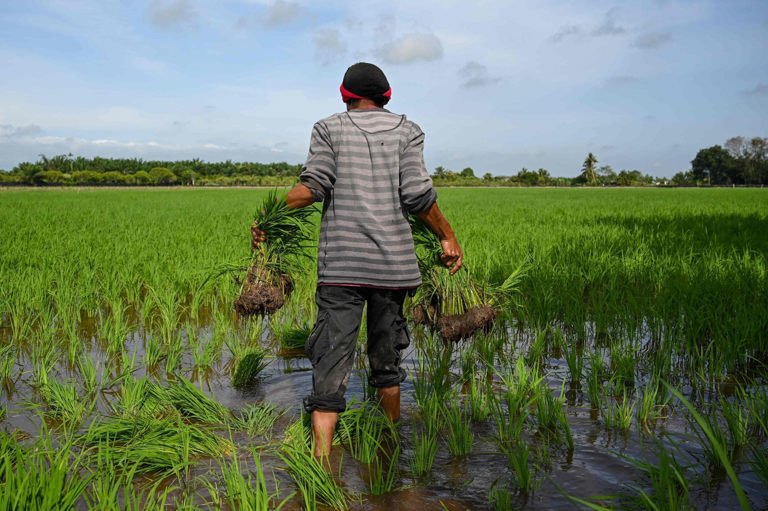
Government ramps up climate mitigation efforts to reduce risks to agricultural production and rural incomes
Malaysia has launched emergency cloud-seeding operations to protect domestic rice production after prolonged drought conditions delayed planting activities across the country’s northern rice belt, raising concerns over food security and farmer incomes.
Prime Minister Anwar Ibrahim announced the deployment of cloud-seeding operations aimed at triggering rainfall in major rice-producing areas, particularly in Kedah, which serves as one of the country’s most strategically important agricultural regions. The intervention comes as farmers across northern Malaysia face severe water shortages, low reservoir levels and delayed planting schedules amid intensifying dry weather conditions.
“This year has been affected by prolonged dry weather, low rainfall and reduced dam water levels,” said Mohamad Sabu, Malaysia’s Minister of Agriculture and Food Security. The drought has disrupted two of the three regular planting cycles used for wet direct seeding, a cultivation method that depends on flooded paddy fields for rice germination and early crop development.
Although dry direct seeding remains an alternative planting method, many farmers said scattered rainfall and rising operational costs have complicated cultivation efforts while also reducing expected yields. Malaysia consumes roughly 2.5 million tonnes of rice annually, with domestic production accounting for approximately half of total demand.
Most of the country’s rice supply originates from northern Peninsular Malaysia, particularly Kedah, which plays a central role in national food security planning. The Agriculture Ministry said more than 50 per cent of rice fields in affected areas have been prepared for planting, though only a small portion has been cultivated as farmers continue waiting for sufficient rainfall.
According to local reports, water levels at the key reservoir serving the Muda Agricultural Development Authority region have fallen to around 8 per cent capacity. “Planting has not been cancelled, but temporary adjustments and mitigation measures are being implemented,” Mohamad Sabu said.
Cloud seeding involves dispersing substances such as silver iodide or salt particles into suitable cloud systems using aircraft in an effort to stimulate rainfall formation. However, meteorologists noted that the success of cloud-seeding operations remains heavily dependent on existing atmospheric and cloud conditions.
The Malaysian government is also expanding fuel subsidy support and financial assistance programmes to help farmers manage rising cultivation costs, which have been exacerbated by global energy market volatility linked to geopolitical tensions in the Middle East.
Farmers said increasing diesel prices and irrigation disruptions have significantly raised production costs during an already difficult growing season. “Even where water is available, many cannot afford to proceed due to high costs,” said Abdul Rashid Yob, a rice farmer in Kedah managing approximately three hectares of paddy land.
Some growers have also called for higher paddy prices to provide more sustainable financial relief.
“Farmers prefer that support be given by increasing the paddy price,” said small-scale rice farmer Fitri Amit from Perak. “If the paddy price is guaranteed, once they sell, they get the money,” he said. Agricultural officials warned that the current drought conditions could intensify further if a strong El Niño weather event develops later this year.
Climate forecasters have indicated that El Niño conditions could emerge between May and July, potentially triggering severe heatwaves, prolonged drought and shifting rainfall patterns across parts of Asia. Malaysia has experienced weather-related disruptions to rice cultivation in previous years, but officials acknowledged that current conditions are proving more severe due to extended heatwaves and rapidly declining water reserves.
Industry analysts said the crisis highlights growing vulnerabilities within Southeast Asia’s agricultural supply chains as climate volatility increasingly threatens food production, irrigation systems and rural livelihoods. The Malaysian government is expected to continue monitoring reservoir conditions, crop progress and weather developments closely over the coming months as part of broader efforts to stabilise domestic rice supply and protect food affordability.
