
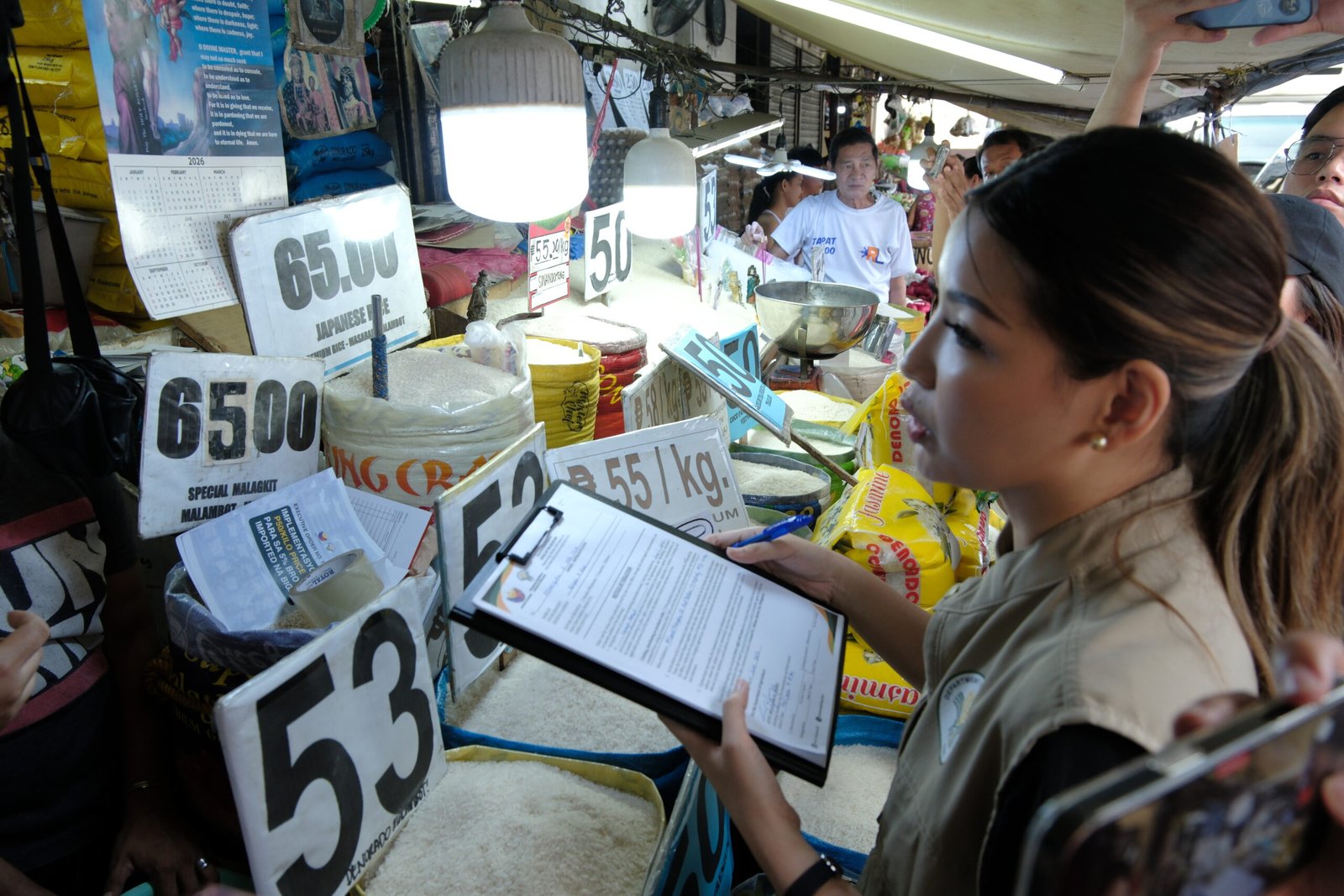
Department of Agriculture expands nationwide inspections, issues violation notices to non-compliant retailers and targets supply-chain irregularities under the P50-per-kilo rice ceiling policy
The Philippine Department of Agriculture (DA) has escalated its nationwide enforcement campaign to uphold the government’s P50-per-kilogram price ceiling on imported rice with 5 percent broken grains, deploying inspection teams across key public markets and issuing multiple notices of violation to retailers found circumventing the mandated pricing rules.
The intensified monitoring effort reflects Manila’s determination to ensure that declining global rice prices are transmitted to domestic consumers, while reinforcing broader government initiatives aimed at curbing food inflation and safeguarding household purchasing power.
Agriculture officials reported a gradual improvement in compliance levels since the implementation of the price cap, attributing the trend to sustained market surveillance and the increased involvement of law enforcement agencies in monitoring retail activity.
Simultaneous inspections were conducted across Metro Manila and several provincial regions, underscoring the government’s commitment to enforcing Executive Order No. 118 and ensuring that rice remains accessible to Filipino consumers amid ongoing cost-of-living pressures.
At Dagonoy Market in San Andres, Manila, inspectors encountered a largely shuttered marketplace, with most rice vendors absent during the visit. Market administrators informed authorities that retailers were attending a scheduled summer outing. Police Major General Edgar Alan Okubo subsequently confirmed that law enforcement personnel would return to inspect the closed stalls and submit additional compliance reports to the Department of Agriculture.
At Trabajo Market in Sampaloc, Manila, a monitoring team led by Assistant Secretary Wiann Angsiy issued a notice of violation after discovering that a retailer had altered product labeling upon the inspectors’ arrival. Authorities reported that imported rice had initially been displayed at P55 per kilogram, exceeding the government-imposed ceiling before the signage was changed.
Similar enforcement actions were undertaken at Alabang Central Public Market, where Undersecretary Cheryl Marie Natividad-Caballero and Assistant Secretary Arnel de Mesa issued violation notices to retailers selling imported premium rice at P60 per kilogram and to several vendors accused of improperly labeling local rice as imported rice.
The inspections also brought renewed attention to concerns raised by retailers regarding supply-chain economics. Some vendors argued that prevailing wholesale prices leave limited room for profitability under the government-mandated ceiling, particularly when imported rice is acquired from suppliers at elevated rates.
Assistant Secretary Angsiy acknowledged these concerns but emphasized that such claims must be substantiated through disclosure of supply sources.
“If retailers claim they are unable to earn because suppliers are charging excessive prices, they must identify those suppliers so authorities can investigate importers or wholesalers potentially selling at unjustifiable levels,” she said.
Authorities are also investigating allegations of product misrepresentation, including cases in which imported rice may have been marketed as locally produced rice to justify higher retail prices. However, officials stressed that formal enforcement actions will depend on laboratory analysis conducted by the Bureau of Plant Industry, which is examining rice samples collected during the inspections.
The Department of Agriculture signaled that surprise inspections would continue for as long as the price ceiling remains in force, with enforcement teams expected to maintain a visible presence in markets nationwide.
The latest compliance drive resulted in 36 notices of violation, distributed across several regions. The Ilocos Region (Region I) accounted for the highest number with 19 notices, followed by the National Capital Region with 8, Central Luzon (Region III) with 4, the Negros Island Region with 3, and the Bicol Region (Region V) with 2.
According to reports submitted by regional field offices, the nationwide compliance rate reached 47.42 percent during the most recent round of coordinated inspections, indicating gradual progress but also highlighting the continuing challenge of achieving full adherence across the rice retail sector.
The enforcement campaign forms part of a broader government strategy to stabilize food prices and improve access to affordable staples for Filipino households. Rice remains one of the most significant components of household expenditure in the Philippines, making its affordability a critical economic and political priority.
While officials remain optimistic that sustained enforcement will strengthen compliance and protect consumers from unjustified price increases, the concerns voiced by retailers illustrate the complexities of implementing price controls within an intricate supply chain that extends from importers and wholesalers to public market vendors.
As the government continues to balance consumer protection with market realities, the success of the price-cap policy may ultimately depend not only on retail enforcement but also on addressing pricing dynamics further upstream in the country’s rice distribution network.
