
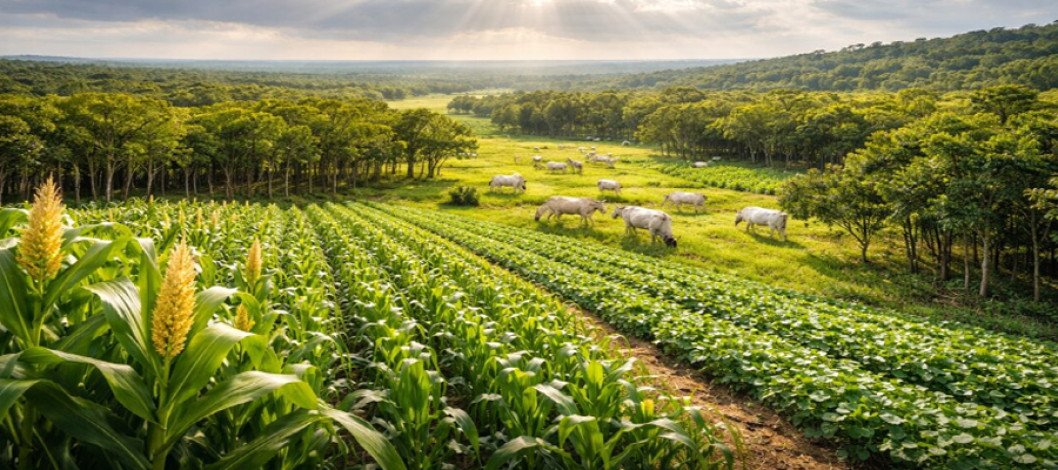
Bioinsumos initiative forms part of Brazil’s broader push toward climate-smart agriculture and food security transformation
Brazilian Development Bank has announced a new BRL 40 million funding round, equivalent to approximately Rs 340 crore, under its Bioinsumos programme to accelerate the adoption and local production of biological agricultural inputs across Brazil.
The initiative forms part of the bank’s broader strategy to strengthen sustainable agriculture, climate resilience and food security by expanding access to bio-based farming technologies among family farmers and rural cooperatives.
The newly announced funding round will provide non-repayable financial support to cooperatives and associations of smallholder farmers for the production and multiplication of bio-inputs at the farm level.
Applications for the programme remain open until August 31.
The announcement was made during a plenary session of National Council for Food and Nutrition Security, highlighting the initiative’s alignment with Brazil’s wider food system transformation agenda.
The Bioinsumos programme is focused on promoting decentralised and localised production of biological agricultural inputs, including microbial inoculants, biofertilisers, biological pest control agents, beneficial insects, biostimulants and enzymatic formulations.
The initiative is intended to reduce dependence on conventional synthetic agrochemicals while improving production efficiency and lowering input costs for small-scale producers.
According to BNDES, the programme supports both industrial and semi-industrial production units, provided proposed projects demonstrate technical viability, biosafety standards and scalability.
Eligible project categories under the funding programme include microbial inoculants, biostimulants, biological pest control technologies, composting systems, fermented organic compounds and plant biomass-derived biofertilisers.
The first funding cycle launched in 2025 allocated BRL 20 million to four selected projects, which are currently undergoing advanced technical evaluation before formal contracting.
BNDES said organisations that were not selected in the first round are encouraged to reapply after incorporating technical feedback provided during the evaluation process.
The initiative forms part of a much broader push by Brazil to transform agricultural production systems through sustainability-focused investments.
Since 2023, BNDES has allocated more than BRL 2.4 billion toward projects linked to sustainable agriculture, food security and social inclusion.
“Bio-inputs represent a strategic pathway to reduce dependence on conventional inputs while strengthening local production capacity,” said Aloizio Mercadante, President of BNDES.
“This initiative supports innovation in the field while promoting greater autonomy for family farming,” Mercadante said.
The programme also reflects accelerating global momentum around biological agricultural products as governments and producers seek climate-smart alternatives to synthetic fertilisers and pesticides amid rising regulatory pressure and volatile commodity prices.
By encouraging decentralised production ecosystems, Brazilian policymakers aim to support agroecological transition strategies while improving resilience and competitiveness among smaller agricultural producers.
Beyond bio-inputs, BNDES is expanding investments across several major rural development initiatives.
These include Sertão Vivo, a BRL 1 billion programme designed to support climate adaptation and productivity gains in Brazil’s semi-arid regions, and Ecoforte, a nationwide initiative promoting agroecology and organic farming systems.
The bank is also supporting Cerrado + Cooperativo, a BRL 50 million programme focused on sustainable production systems and market access within Brazil’s Cerrado biome.
In the Amazon region, projects such as Amazonia na Escola and Sanear Amazônia are integrating agriculture, food distribution, sanitation and infrastructure development to support rural livelihoods and environmental conservation.
Industry analysts said the expansion of public financing for biological inputs could further accelerate Brazil’s emergence as one of the world’s largest growth markets for sustainable agricultural technologies.
For agri-input manufacturers and agtech companies, the programme signals growing institutional support for biological solutions not merely as supplementary tools, but as core components of future agricultural production systems.
The success of decentralised production models under the programme is expected to be closely monitored by policymakers, investors and industry stakeholders across global agricultural markets.
