
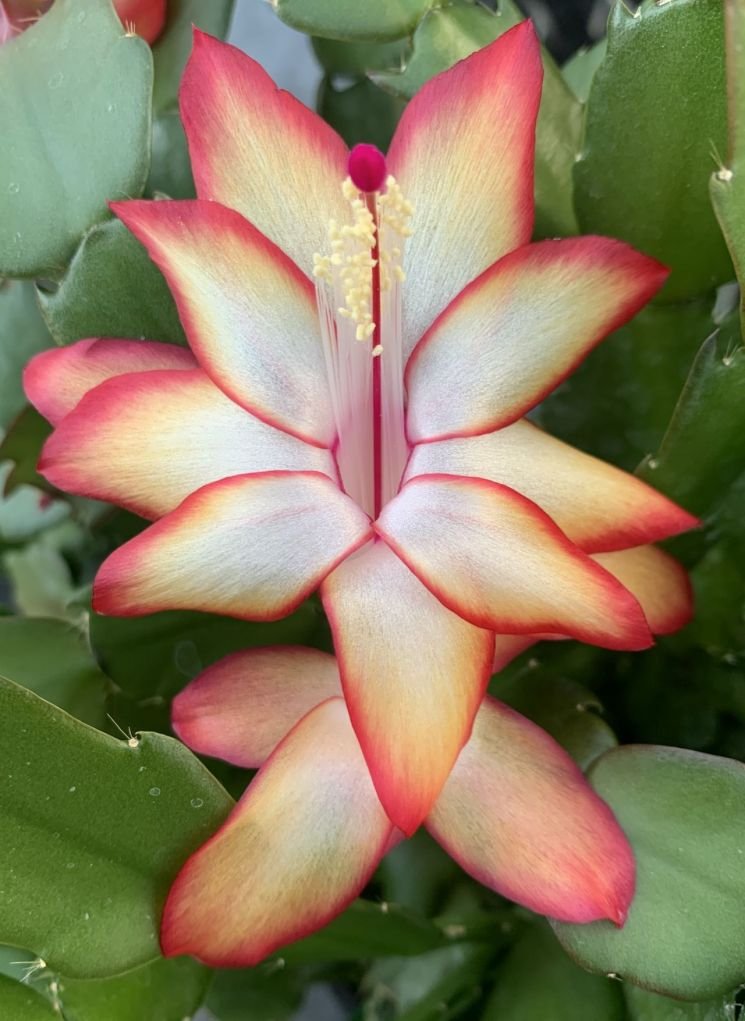
Researchers from Gyeonggi-do Agricultural Research and Extension Services unveil two new prickly pear cactus varieties
Korea’s Gyeonggi-do Agricultural Research and Extension Services has launched two new varieties of the prickly pear cactus developed through its own breeding technology: ‘Dual Label’ and ‘Gold Label’.
The prickly pear cactus is a plant native to the tropical rainforests of Brazil. It grows attached to trees or rocks and blooms even during the winter season.
‘Dual Label’ is a variety in which a single flower simultaneously displays three colors: pink at the edge of the petals, yellow in the middle, and white on the inside. Unlike existing varieties that feature mainly single colors, its distinct color contrast enhances its ornamental value, leading to anticipated market demand.
‘Gold Label’ features a soft golden hue and a uniform flower shape. According to on-site farm trials, it has received favorable evaluations for its consistent blooming and stable coloration, making it highly suitable for indoor ornamental use and as a gift.
Both varieties are scheduled to be released to the market this year and are expected to help improve the import-dominated market structure and expand the presence of domestic varieties.
The provincial Agricultural Research and Extension Services has been selecting genetic resources and accumulating data focused on flower color and shape to match consumer preferences for the past five to ten years, utilizing this information for breeding purposes.
Breeding refers to the agricultural technology of developing and disseminating new crop or livestock varieties with higher practical value than previous ones through improvement. Varieties developed by this method adapt well to the market, enabling them to gain competitiveness quickly.
Jung Yun-kyung, Director of the Cactus and Succulent Research Institute at the Gyeonggi-do Agricultural Research and Extension Services, said, “We will continue to develop varieties suited to domestic cultivation conditions and strengthen data-driven breeding to lead the development of new floral varieties.”
