
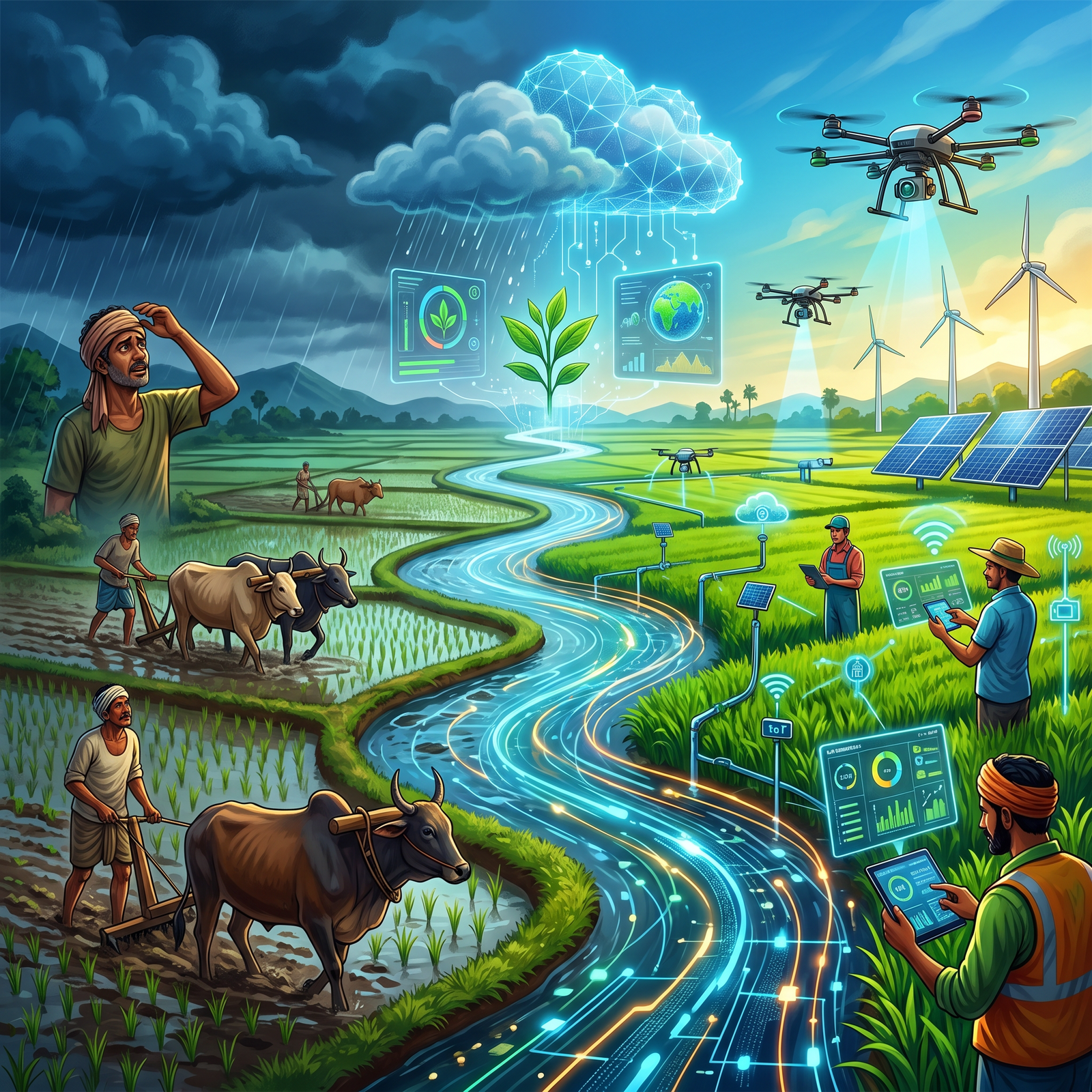
In an AgroSpectrum webinar featuring experts from HyFarm, BioPrime AgriSolutions and Crystal Crop Protection, the conversation shifted beyond rainfall forecasts to the technologies and strategies that will define resilient farming in the years ahead

The debate surrounding the 2026 southwest monsoon has largely been framed around a single phrase: “below normal.” Yet, as industry leaders, scientists and agribusiness executives argued during AgroSpectrum’s recent webinar, the bigger challenge facing Indian agriculture is not whether seasonal rainfall is marginally above or below the long-period average. It is the growing unpredictability of rainfall distribution, temperature fluctuations and extreme weather events that are fundamentally altering the economics and biology of crop production.
The webinar brought together three leading voices from across the agricultural value chain—S. Soundararadjane, Chief Executive Officer, HyFarm; Dr. Renuka Diwan, Co-Founder & Chief Executive Officer, BioPrime AgriSolutions Pvt. Ltd.; and Satyender Singh, Chief Executive Officer – Seeds, Crystal Crop Protection Ltd. Together, they offered a sobering yet solution-oriented assessment of how Indian agriculture must evolve to navigate a future defined by climatic uncertainty.
What emerged was a consensus that the agricultural sector is entering a new operating paradigm—one where resilience, rather than maximisation, becomes the defining metric of success.
The Monsoon Is No Longer the Only Story
Opening the discussion, S. Soundararadjane challenged the tendency to view monsoon performance solely through aggregate rainfall numbers.
“Climate change is no longer an emerging threat for Indian agriculture—it is the operating reality,” he observed. “The challenge today is not merely deficient rainfall. It is variability itself.” For decades, Indian agriculture managed around reasonably predictable seasonal cycles. Farmers could anticipate sowing windows, crop growth stages and harvest periods with a degree of confidence. That predictability has now eroded.

“Climate change has fundamentally altered the rules of farming. The challenge today is not simply drought or excess rainfall—it is variability itself. Farmers are no longer managing a single season; they are managing multiple microclimatic disruptions within that season. In this environment, precision agriculture is no longer a technology upgrade but a critical risk-management system that enables farmers to make informed, hyper-local decisions and convert uncertainty into resilience.”
— S. Soundararadjane, Chief Executive Officer, HyFarm
According to Soundararadjane, farmers are increasingly dealing with multiple climatic disruptions within the same season. Delayed monsoons may be followed by sudden heavy downpours. Excess rainfall events are often succeeded by prolonged dry spells. Temperature fluctuations are becoming more severe, while humidity shifts are creating favourable conditions for new pest and disease outbreaks.
“The farmer is no longer managing a season,” he remarked. “He is managing microclimatic uncertainty within the season.” This distinction is crucial. A monsoon categorised as “normal” at the national level may still create severe localised production losses if rainfall arrives at the wrong time, in the wrong quantity, or is concentrated within a few extreme weather events. For farmers, distribution matters as much as volume.
Climate Risk Is Becoming Layered and Simultaneous
If Soundararadjane framed the problem through the lens of weather variability, Dr. Renuka Diwan expanded the discussion by examining its biological implications. According to Renuka, the climate challenge confronting agriculture today is fundamentally different from what farmers faced even a decade ago.
“The issue today is not that climate-related vagaries exist. We know they exist and we have accepted that,” she explained. “The issue is that a farmer can face drought-like conditions during crop establishment and then confront excessive rainfall, waterlogging and humidity-related disease pressures within the same season.”
Historically, drought management, flood management and disease management were treated as separate agricultural problems. Today, those challenges are increasingly overlapping. Farmers may experience moisture stress during sowing, followed by flooding during vegetative growth, and then encounter disease outbreaks triggered by prolonged humidity.
“The agricultural calendar is no longer characterised by predictable seasonal transitions,” Renuka said. “It is increasingly shaped by rapid and unpredictable climatic shifts.” This reality, she argued, exposes the limitations of conventional agricultural approaches that were designed around relatively stable environmental conditions.
Precision Agriculture: From Technology Upgrade to Risk Management System
For Soundararadjane, the most significant response to climate volatility lies in precision agriculture. Importantly, he argued that precision farming should not be viewed as a productivity enhancement tool alone. “Precision agriculture is not simply a technology intervention,” he said. “It is a risk-management framework.”
The first pillar of this framework is hyper-local weather intelligence.
Advances in weather stations, soil sensors, satellite monitoring and digital forecasting platforms now allow farmers to access highly localised information rather than relying solely on district- or state-level advisories.

“Climate volatility has fundamentally changed the nature of agricultural risk. Farmers are no longer dealing with isolated challenges such as drought, flooding or heat stress—they are increasingly confronting all of them within the same season. In this environment, resilience cannot be built through any single intervention. The future of agriculture lies in intelligently integrating biologicals, precision agronomy, digital advisories and conventional crop protection tools into a unified, farmer-centric ecosystem.”
— Dr. Renuka Diwan, Co-Founder & Chief Executive Officer, BioPrime AgriSolutions Pvt. Ltd.
In crops such as potato, where HyFarm has implemented precision farming models across Gujarat and Madhya Pradesh, weather stations and soil moisture sensors have fundamentally altered decision-making. Farmers receive mobile-based advisories indicating precisely when irrigation is required and when it can be deferred.
The results have been significant.
According to Soundararadjane, farmers participating in these programmes have reduced water usage by 30–35 per cent despite already operating drip irrigation systems. Fertiliser consumption has declined by 12–15 per cent, while overall cultivation costs have fallen by nearly 15 per cent. “The objective is not to generate more data,” he noted. “The objective is to convert data into actionable decisions.”
The broader lesson, he argued, is that future agricultural competitiveness will increasingly depend on a farmer’s ability to respond intelligently to climatic variability rather than simply endure it.
Why Biological Solutions Are Becoming Increasingly Relevant
While precision agriculture focuses on decision-making, Renuka highlighted the growing role of biological technologies in enhancing crop resilience. However, she cautioned against simplistic narratives.
“Biologicals are not a silver bullet,” she said. Much of the marketing around stress-management products, she noted, often fails to recognise that plant stress develops in stages. At the earliest stage, plants begin sensing environmental disruption and activating internal defence pathways. Many biological products can effectively support recovery during this phase.
As stress intensifies, however, plants experience oxidative bursts that damage cellular systems. At this stage, only specialised interventions can restore physiological balance. Beyond a certain threshold, visible crop damage emerges. Cellular membranes, proteins and DNA structures may already be compromised.

“Climate change has transformed unpredictability into agriculture’s defining challenge. Farmers today need more than high-yielding varieties; they need seeds capable of delivering stable performance under highly variable weather conditions. Climate resilience is no longer a desirable trait in breeding—it has become an essential requirement for sustaining productivity, profitability and food security.”
— Satyender Singh, Chief Executive Officer – Seeds, Crystal Crop Protection Ltd
“At that point, recovery becomes significantly more difficult,” Renuka explained. This distinction reinforces an important principle: biological solutions must be deployed proactively rather than reactively.
The effectiveness of biological interventions depends not only on the product itself but also on timing, crop condition and environmental context. “Not all biologicals are able to withstand all kinds of stress,” she observed. “The power lies in understanding what kind of stress is occurring, how severe it is, and what intervention is needed.”
The End of One-Size-Fits-All Agriculture
One of the strongest themes to emerge from the webinar was the growing irrelevance of uniform agricultural recommendations. India’s extraordinary agro-climatic diversity has always required local adaptation. Climate change is amplifying that requirement.
According to Renuka, many agricultural solutions deployed historically were developed outside India and adapted domestically with limited localisation. “That one-size-fits-all approach is rapidly becoming obsolete,” she argued.
A new generation of agricultural innovation is increasingly focused on region-specific and crop-specific solutions designed around local climatic realities. The shift is evident not only in biologicals but also in crop breeding.
Seeds Are Becoming Agriculture’s First Climate Defence
For Satyender Singh, climate resilience begins long before the crop enters the field. “The conversation around climate change often focuses on delayed monsoons,” he observed. “But the bigger challenge is unpredictability itself.”
According to Singh, climate variability is fundamentally reshaping breeding priorities across the seed industry. A decade ago, a single variety could often perform successfully across broad geographic regions. Today, that model is becoming increasingly untenable. Breeders are now developing varieties tailored to specific rainfall windows, sowing periods and environmental conditions. He cited millet cultivation as an example.
“In Rajasthan, if rainfall arrives in May, farmers may require one variety. If monsoon onset shifts by several weeks, an entirely different variety may be required,” Singh explained. This level of specificity reflects a larger industry shift toward climate-responsive genetics. Breeding programmes today must simultaneously address drought tolerance, heat resilience, disease resistance, nutrient-use efficiency and shorter growing cycles.
The objective is no longer simply maximising yield potential. “The focus is increasingly on delivering stable performance under variable conditions,” Singh noted.
Why Short-Duration Varieties Matter
One important breeding trend highlighted by Singh is the development of shorter-duration crop varieties. As climatic unpredictability increases, reducing a crop’s exposure to weather-related risks becomes strategically important.
Short-duration hybrids allow farmers to complete crop cycles faster while maintaining productivity. They also improve nutrient-use efficiency and provide greater flexibility in managing delayed sowing windows. “The longer a crop remains exposed to unpredictable weather, the greater the production risk,” Singh explained. Short-duration genetics therefore represent an increasingly valuable adaptation strategy for both farmers and breeders.
Beyond Yield Maximisation: The Rise of Risk-Adjusted Productivity
Across all three expert perspectives, a common theme emerged. The future of Indian agriculture will require a shift away from yield maximisation as the sole objective. Instead, success will increasingly be measured through what Soundararadjane described as risk-adjusted productivity. In practical terms, this means maintaining stable and profitable output despite environmental uncertainty.
Precision agriculture contributes through data-driven decisions. Biologicals contribute through enhanced plant resilience. Climate-smart seeds contribute through genetic adaptation. Together, they form complementary components of a broader resilience framework. As Renuka succinctly observed: “The future is not about biologicals versus chemicals. It is about integration.”
The Policy Imperative: Building the Innovation Ecosystem
The discussion concluded by examining the policy and structural reforms needed to sustain farmer profitability and national food security.
For Singh, the starting point is greater investment in agricultural innovation. “Developing climate-resilient seeds is becoming increasingly complex,” he said. “It requires advanced breeding tools, greater scientific investment and longer development cycles.”
He argued that India must strengthen support for agricultural research while creating a predictable intellectual property environment that encourages innovation.
The existing Protection of Plant Varieties and Farmers’ Rights (PPV&FR) framework has played a valuable role, but emerging technologies such as gene editing, precision breeding and advanced molecular tools require updated regulatory pathways. “Countries around the world are increasingly using advanced breeding technologies to develop crops that tolerate drought, heat, salinity and disease pressures,” Singh noted. “India must ensure its regulatory ecosystem allows researchers and innovators to access these tools responsibly and efficiently.”
Equally important is deeper collaboration between public research institutions, private-sector breeders and policymakers. “Climate resilience cannot be achieved through isolated efforts,” he emphasised. “It requires an integrated innovation ecosystem where scientific discoveries move rapidly from research stations to farmers’ fields.”
The New Measure of Agricultural Success
If there was one overarching conclusion from the webinar, it was that the monsoon itself is no longer the most important variable in Indian agriculture. What matters increasingly is how farmers, technologies, seeds, biologicals and institutions respond to variability. The experts agreed that climate uncertainty is likely to remain a permanent feature of agriculture. The question is not whether farmers will face disruptions, but whether the sector can build systems resilient enough to absorb them.
Precision agriculture, climate-resilient genetics, biological innovations and supportive policy frameworks are no longer optional enhancements. They are becoming foundational requirements for sustaining productivity, profitability and food security. As Indian agriculture enters an era where unpredictability is the norm rather than the exception, resilience may well become the most valuable crop the sector can cultivate.
— Suchetana Choudhury (suchetana.choudhuri@agrospectrumindia.com)
