
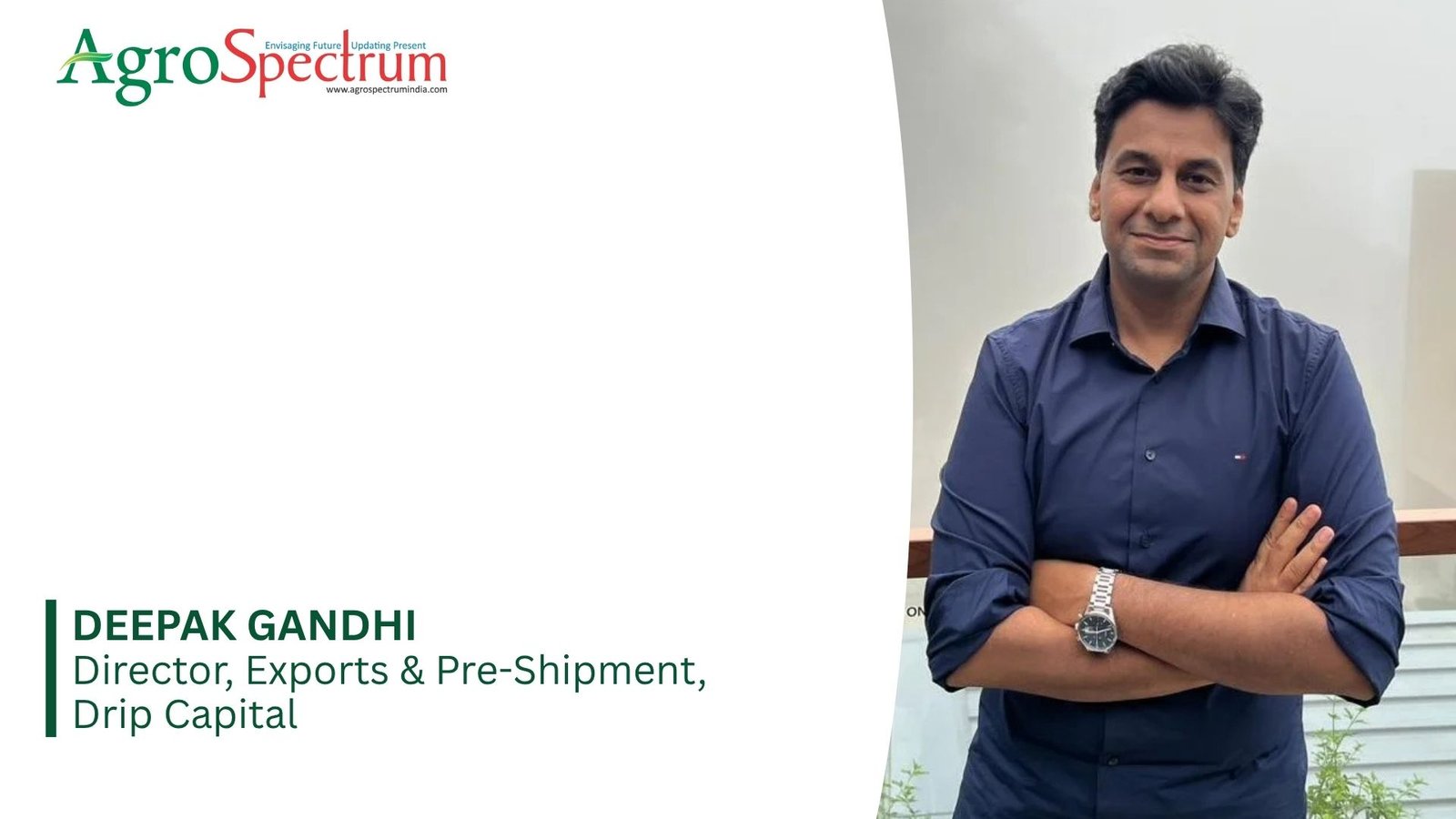
Deepak Gandhi, Director – Exports & Pre-Shipment at Drip Capital, explains how data-driven invoice financing is helping seafood exporters unlock working capital, reduce dependence on collateral, strengthen supply-chain resilience and scale global trade through faster, more transparent access to credit
In an exclusive Agrospectrum interview, Deepak Gandhi, Director – Exports & Pre-Shipment at Drip Capital, highlights how invoice financing bridges the structural working capital gap faced by India’s seafood exporters by unlocking up to 80 per cent of receivables quickly, enabling continuous operations. He explains that a data-driven underwriting model—focused on trade flows, buyer behaviour, and transaction-level insights—allows SMEs to access collateral-free credit despite limited financial histories.
Gandhi emphasises the need for integrated trade finance solutions that combine pre-shipment, inventory, and post-shipment funding to support value-added exports with longer production cycles. He also underscores that scaling export growth will require stronger digital infrastructure, interoperable trade ecosystems, and access to low-cost global capital to make invoice financing a foundational enabler for MSMEs.
India’s seafood exporters often operate on thin margins with extended receivable cycles. How does invoice financing structurally address the working capital asymmetry between production timelines and delayed international payments, particularly for SMEs in the marine sector?
The working capital gap in seafood exports is structural. Exporters incur nearly 100 per cent of procurement, processing, and logistics costs upfront, while payments from international buyers typically come 60–90 days later.
Invoice financing addresses this mismatch by converting receivables into immediate liquidity. We support exporters across the cycle, including pre-shipment, by enabling up to 80 per cent of the invoice value within 24-48 hours of approval. This allows businesses to quickly reinvest into the next cycle. For MSMEs, this is critical. It shifts them from operating in isolated cycles to running continuous, scalable operations without being constrained by cash flow timing.
With global seafood demand rising but subject to price volatility, regulatory shifts, and currency fluctuations, how does Drip Capital dynamically price risk in export receivables without overburdening exporters with high financing costs?
Today’s volatility is being driven by currency movements, demand fluctuations, regulatory shifts, and ongoing global supply chain disruptions. In this environment, access to timely and predictable working capital becomes critical for exporters and importers.
Our approach is to leverage trade data and transaction-level insights to underwrite businesses more efficiently, enabling faster and more seamless access to financing. By focusing on real trade flows and performance, we simplify the financing process and reduce the operational burden typically associated with cross-border trade.
We support global trade by covering payments across markets, helping businesses manage working capital more effectively while navigating ongoing trade and FX complexities.
As India moves up the value chain from raw exports to processed and value-added seafood, how does trade finance evolve to support longer production cycles, higher input costs, and more complex buyer contracts?
As exporters move up the value chain into processed and ready-to-cook segments, working capital intensity increases materially, driven by longer production cycles, higher labour and input costs, and tighter compliance requirements.
In my view, post-shipment finance alone is no longer sufficient. What’s evolving is a more integrated approach to trade finance, i.e. combining pre-shipment support, inventory financing, and purchase order-backed funding.
This allows exporters to take on larger, more complex contracts without stretching their balance sheets, while ensuring liquidity is available across the entire trade cycle, not just after shipment.
Traditional trade finance relies heavily on collateral and banking relationships. How is your data-driven underwriting model redefining creditworthiness for seafood exporters who may lack formal financial histories but have strong trade performance?
Traditionally, trade finance has excluded a large segment of exporters because it relies heavily on collateral and established banking relationships.
Our model underwrites the trade itself. We look at shipment data, buyer payment behaviour, frequency of trade, and corridor-level risk to assess creditworthiness.
This allows us to extend collateral-free credit lines of up to $3 million, even to exporters with limited formal financial history but strong underlying trade performance. Effectively, data replaces physical assets as the basis for credit.
In an industry vulnerable to climate risks, logistics disruptions, and perishability constraints, how critical is continuous liquidity in maintaining supply chain resilience—and what role does invoice financing play in preventing systemic shocks?
If you consider seafood supply chains, they are highly exposed to climate events, freight disruptions, and perishability risks. In such a system, liquidity has to be continuous, any break in working capital flow directly impacts production and fulfillment. Invoice financing plays a critical role by unlocking capital tied up in receivables, ensuring exporters don’t have to slow down operations due to delayed payments.
Many Indian seafood exporters depend on a limited number of international buyers. How does Drip Capital assess and mitigate counterparty risk, especially in cases where exporter exposure is concentrated across a few geographies or clients?
Concentration risk is a reality in seafood exports, especially when exporters rely on a limited set of buyers or geographies.
Our approach is to assess risk at a granular, buyer-by-buyer level. We track payment behaviour, historical performance, and exposure limits for each counterparty, rather than evaluating the exporter as a whole.
We then actively manage this through dynamic credit limits, diversification across buyers and corridors where possible, and selective exposure based on real-time risk signals. This ensures that even if an exporter is concentrated, the risk is calibrated and contained at the transaction level, rather than becoming a systemic vulnerability.
With increasing digitiszation in export documentation, logistics tracking, and compliance, how is Drip Capital integrating with digital trade ecosystems to create a seamless financing layer embedded within export workflows?
As trade becomes more digitised across documentation, logistics, and compliance, exporters are generating more structured data across their workflows. We leverage this data to streamline access to financing and make the overall experience faster and more transparent.
Our platform is fully digital, allowing exporters to access working capital with minimal friction. Financing is aligned closely with underlying trade transactions, enabling businesses to unlock liquidity at the right time in their export cycle.
As India aims to significantly expand its share in global seafood exports, what systemic changes—in policy, fintech infrastructure, or capital availability—are required for trade finance and invoice financing to scale as foundational enablers of export growth?
The starting point is empowering MSME exporters with the right tools. The tools should be designed to help them improve efficiency, upgrade processing, and consistently meet higher quality standards.
On the policy side, it’s not just about incentives but sustained focus on ease of doing business, faster export documentation, and stronger infrastructure to enhance global competitiveness. Equally important is enabling frameworks for digital trade data sharing.
From a fintech perspective, standardisation and interoperability across logistics, customs, and financing platforms will be key to enabling real-time data flow and scaling embedded finance. Finally, access to deeper pools of low-cost, globally diversified capital is critical to ensure MSMEs have consistent liquidity at competitive rates.
Once these pieces come together, invoice financing can move from being a niche offering to a foundational enabler of export growth.
—- Suchetana Choudhury (suchetana.choudhuri@agrospectrumindia.com)
