
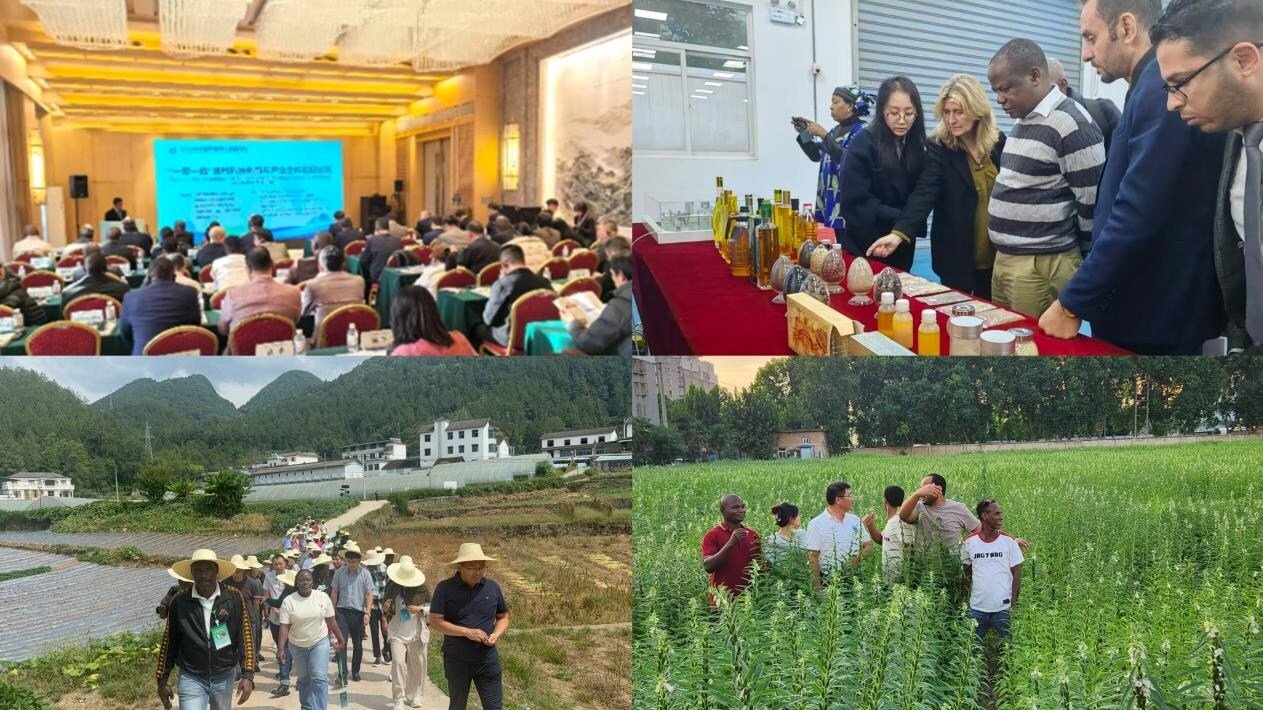
Joint research and innovation on oilseed crops
Africa’s rich diversity of oilseed crops, such as sesame, peanuts, and soybeans, is essential for food security, rural livelihoods, and expanding export markets across the continent. To better harness this potential and address the priorities of the FOCAC Beijing Action Plan (2025-2027), African and Chinese scientists are intensifying joint research and innovation on oilseed crops.
Policymakers, researchers, and private sector representatives from Algeria, Egypt, Ethiopia, Mali, Madagascar, Nigeria, Tanzania, and other countries met with their Chinese counterparts in Wuhan at the Belt and Road Forum on Oil Crops Science, Technology Innovation, and Industrial Cooperation. The forum, jointly organized by the Oilseed Research Institute of the Chinese Academy of Agricultural Sciences (OCRI-CAAS), the CAAS Agricultural Information Institute, and international partners, focused on strengthening collaboration across the entire value chain—from breeding and seed systems to processing and trade.
Participants discussed new opportunities for sesame and other oilseed crops, including the joint breeding of climate-resistant, high-yielding, high-quality varieties; the demonstration of high-protein legumes adapted to African farming systems; and more efficient, value-added processing of edible oils. During the event, OCRI-CAAS and several African universities and companies signed cooperation agreements that will support long-term partnerships focused on variety improvement, technology transfer and scaling up, and the training of young scientists and agribusiness professionals. These efforts aim to translate science into tangible benefits for farmers and consumers in Africa and China.
The forum was followed by a technical visit to OCRI-CAAS by an African delegation including Edwin Paul Mhede, Deputy Permanent Secretary for Trade and Investment at the Tanzanian Ministry of Industry; Nurudeen Abubakar Zauro, Technical Advisor to the President for Economic and Financial Inclusion at the Office of the Vice President of Nigeria; Lise Korsten, President of the African Academy of Sciences; Logab Djilali, Vice-Rector of the University of Tissemsilt in Algeria; and Erick Vitus Gabriel Komba, Director of the Tanzanian Livestock Research Institute, among others. The delegation met with innovation teams working on sesame and specialty oilseed crops, peanuts, and southern soybeans, and visited national platforms for quality testing and pilot-scale processing of oilseed crops. Professor Korsten and other delegates stressed that the oilseed sector in Africa is poised for rapid growth and that collaborative research with partners such as OCRI-CAAS can help generate locally adapted solutions that increase yields, improve quality and meet international market standards.
Looking ahead, African partner institutions and OCRI-CAAS plan to use the China-Africa Alliance for Agricultural Science and Technology (CAASTIA) as a key platform to deepen cooperation on joint breeding programs, farmer-led extension, and talent development. By combining Africa’s resources and commercial potential with Chinese and African scientific expertise, the partners aim to build more resilient and inclusive oilseed value chains that support food and nutrition security and sustainable development across the continent.
