
Minister Trinh Viet Hung advances cooperation in digital agriculture, climate resilience, sustainable development and high-value food systems as Vietnam strengthens its regional leadership agenda
In a demonstration of Vietnam’s increasingly proactive regional engagement strategy, Minister of Agriculture and Environment Trinh Viet Hung has concluded a series of high-level bilateral meetings with counterparts in Singapore and Thailand, advancing a broad agenda encompassing agricultural innovation, environmental sustainability, digital transformation, climate resilience and food security.
The engagements formed part of the official overseas programme led by General Secretary and President To Lam between May 27 and June 1, 2026, and underscored Vietnam’s growing determination to position itself at the centre of ASEAN’s evolving green and technology-driven growth agenda.
At a time when climate change, resource constraints and food security concerns are reshaping policy priorities across Southeast Asia, the discussions reflected a shared recognition that future agricultural competitiveness will increasingly depend on technological sophistication, sustainability and regional cooperation.
Singapore: Building a Technology-Driven Sustainability Partnership
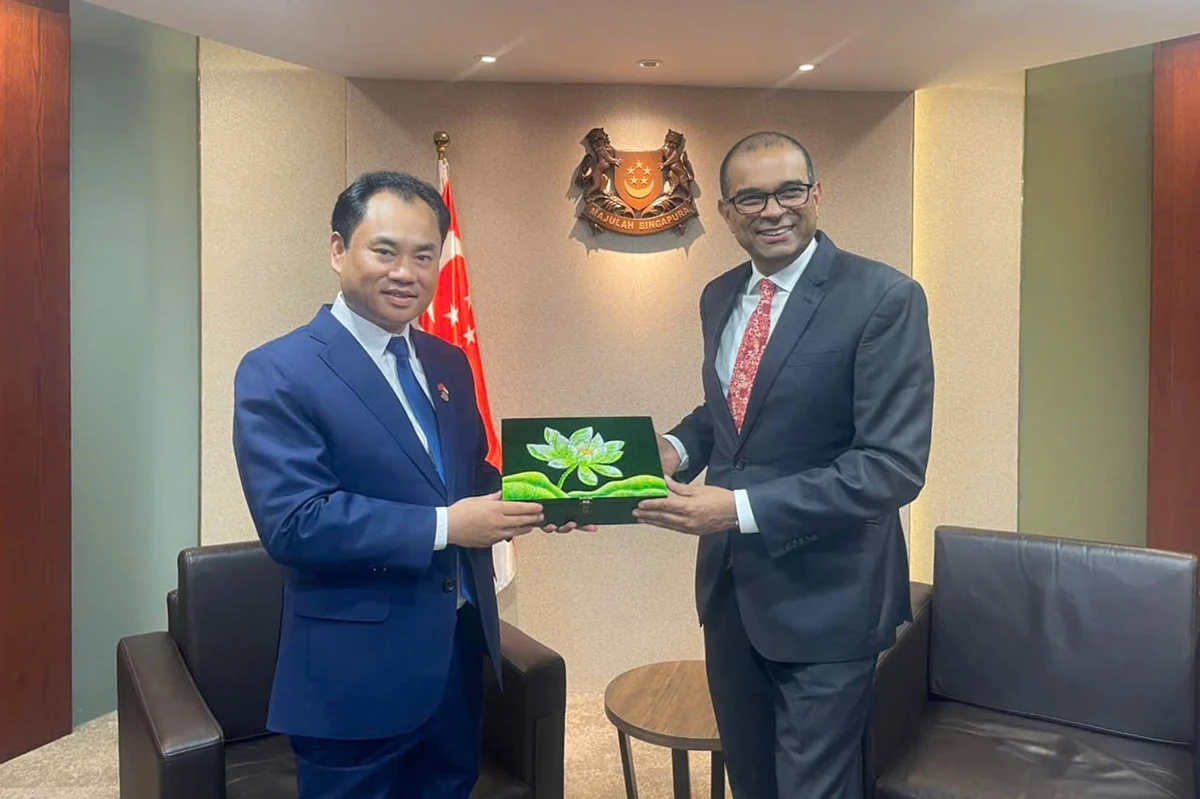
During his visit to Singapore, Minister Hung held substantive discussions with Senior Minister of State for Sustainability and the Environment Janil Puthucheary, focusing on areas where the city-state has emerged as a global leader, including environmental governance, disaster preparedness, digital infrastructure and climate adaptation.
The Vietnamese minister emphasized Vietnam’s interest in expanding collaboration on advanced technologies for disaster prevention, fisheries governance, environmental management and vessel-monitoring systems. He noted that Singapore’s expertise in digital management platforms and predictive monitoring systems could offer valuable lessons as Vietnam seeks to modernize its agricultural and marine resource management frameworks.
The discussions highlighted growing opportunities in digitizing fisheries administration, including vessel registration, fishing licenses, catch monitoring and port management systems—areas increasingly viewed as essential for ensuring sustainability, traceability and compliance with international trade requirements.
Singapore’s delegation outlined the country’s extensive investments in climate adaptation infrastructure, including sophisticated flood management systems, weather forecasting platforms and integrated hydrometeorological monitoring networks. These systems operate under a prevention-first philosophy, enabling authorities to anticipate and mitigate climate-related risks before they escalate into major disruptions.
The exchange also extended to broader sustainability objectives, including carbon reduction, renewable energy deployment, circular economy initiatives and biodiversity conservation. Singapore’s ambitious resource-efficiency agenda, particularly its efforts toward minimizing waste generation and scaling up recycling systems, was highlighted as a potential area for future knowledge exchange.
Minister Hung praised Singapore’s achievements in environmental stewardship and proposed deeper cooperation on low-carbon development pathways, emissions reduction strategies and sustainable resource management frameworks.
As a symbolic gesture of goodwill, the minister presented his Singaporean counterpart with Thai Nguyen tea, one of Vietnam’s most celebrated agricultural products, while extending a formal invitation for Singapore’s Ministry of Sustainability and the Environment to undertake an official working visit to Vietnam in the near future.
Thailand: Strengthening Agricultural Value Chains and Private-Sector Collaboration
The minister’s engagements in Thailand reflected a complementary dimension of Vietnam’s regional strategy—leveraging private-sector partnerships and cross-border investment to accelerate agricultural modernization.
On the sidelines of the 2026 Vietnam–Thailand Business Forum, Minister Hung met with Soopakij Chearavanont, Chairman of Charoen Pokphand Group (C.P. Group), one of Southeast Asia’s largest agribusiness and food companies.
The business forum itself, attended by President To Lam, Thai Prime Minister Anutin Charnvirakul and nearly 700 enterprises from both countries, emphasized emerging growth sectors including semiconductors, electric vehicles, smart agriculture, digital technologies, healthcare and clean energy.
Vietnam’s leadership used the platform to encourage deeper integration of bilateral value chains within the broader ASEAN economic architecture. President To Lam called for the development of a strategic pipeline of collaborative projects spanning logistics, agriculture, food processing, renewable energy, digital trade, tourism and workforce development during the 2026–2030 period.
Against this backdrop, Minister Hung reaffirmed Vietnam’s commitment to supporting long-term investment by C.P. Group, praising the company’s contributions to economic development, employment generation and agricultural transformation.
Particular attention was given to the company’s integrated “Feed–Farm–Food” (3F) model, which has become a prominent example of vertically integrated agricultural production in Southeast Asia.
Chearavanont noted that more than 30,000 Vietnamese employees currently work across the company’s operations in the country. Beyond employment creation, he emphasized the company’s ongoing efforts to strengthen farmer livelihoods through contract farming arrangements, technical support programs and agricultural development initiatives.
The discussions reflected a broader convergence of priorities between Vietnam and Thailand. Both sides identified technology transfer, sustainable livestock production, value-added agricultural processing and climate-smart farming as critical pillars for future cooperation.
Minister Hung encouraged C.P. Group to further expand investments in advanced agricultural technologies, strengthen livestock development programmes, and support Vietnam’s efforts to increase agricultural exports to premium international markets including Japan, South Korea and the European Union.
Agriculture at the Heart of Vietnam’s Regional Growth Strategy
Beyond the bilateral meetings, Minister Hung participated in a series of engagements with major regional and international corporations and institutions, including Sembcorp, SATS, Sea Limited, United Overseas Bank, Aboitiz Foods, Grab, the Asian Development Bank and the World Health Organization.
Collectively, these engagements illustrate Vietnam’s increasingly sophisticated approach to agricultural diplomacy—one that extends beyond traditional trade discussions to encompass innovation ecosystems, sustainability partnerships, digital transformation and investment attraction.
As Southeast Asia navigates a period of profound economic and environmental change, Vietnam appears intent on positioning agriculture not merely as a production sector, but as a strategic platform for technological advancement, climate resilience and regional integration.
The message emerging from the minister’s regional engagements is clear: future agricultural competitiveness will not be built solely through increased production, but through stronger partnerships, smarter technologies and a more integrated approach to sustainable development across ASEAN.
