
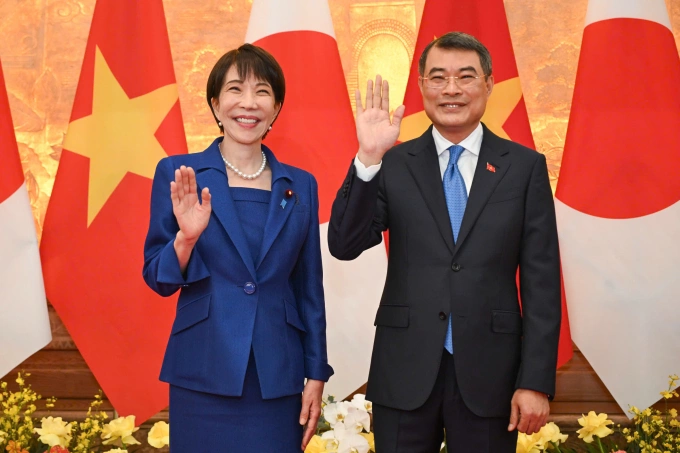
Expanded partnership includes agricultural market access, green transition initiatives, and strategic industrial collaboration
Viet Nam and Japan have agreed to significantly expand bilateral cooperation across economic security, sustainable agriculture, advanced technology, and energy resilience, signaling a new phase in the rapidly evolving strategic relationship between the two Asian economies.
Following high-level talks in Hanoi , Le Minh Hung and Sanae Takaichi outlined an ambitious roadmap aimed at strengthening the Vietnam–Japan Comprehensive Strategic Partnership through deeper investment integration, technology collaboration, and expanded agricultural cooperation.
The discussions reflected growing regional efforts to build more resilient supply chains, reinforce food and energy security, and accelerate industrial transformation amid intensifying geopolitical and economic uncertainty across the Indo-Pacific.
Both countries agreed to pursue measures that would raise annual Japanese investment into Viet Nam to approximately $ 5 billion while targeting bilateral trade turnover of $ 60 billion by 2030.
The partnership is expected to focus heavily on high-technology sectors including semiconductors, artificial intelligence, green transition technologies, digital transformation, and space research, with particular emphasis on human capital development and joint scientific innovation.
Japanese companies were encouraged to expand investment in high-tech manufacturing and technology-transfer projects within Viet Nam, while Vietnamese enterprises are expected to increase participation in Japanese-funded industrial and infrastructure programmes.
Agriculture also emerged as a central pillar of the expanding bilateral agenda.
Both governments committed to accelerating market access negotiations for agricultural products, initially prioritizing Vietnamese green-skinned pomelo and Japanese grapes. The two sides additionally reaffirmed cooperation on food security, agricultural sustainability, and climate-resilient farming systems.
Prime Minister Le Minh Hung also welcomed Japan’s continued support for Viet Nam’s large-scale initiative to develop one million hectares of high-quality, low-emission rice production in the Mekong Delta — a flagship programme designed to strengthen sustainable rice cultivation while reducing agricultural emissions.
Energy security formed another critical dimension of the talks.
The two countries agreed to advance cooperation under the “Partnership for Asia Energy and Resources Resilience” (POWERR ASIA), a regional initiative aimed at improving energy self-reliance and supply-chain resilience across Asia. Under the framework, Japan will support crude oil supply arrangements for Viet Nam’s Nghi Son Refinery and Petrochemical Complex.
The leaders also announced plans to deepen cooperation in economic security, strategic supply-chain diversification, and industrial resilience as governments across the region seek to reduce vulnerabilities stemming from geopolitical fragmentation and global market volatility.
In parallel, Viet Nam and Japan agreed to expand cooperation in defense, cybersecurity, maritime law enforcement, disaster management, and transnational crime prevention, while strengthening ministerial dialogue mechanisms spanning diplomacy, trade, science, technology, and defense affairs.
Prime Minister Sanae Takaichi emphasized Viet Nam’s growing strategic importance within regional and global manufacturing ecosystems, noting that Japanese corporations increasingly view the country as a critical node in international supply chains.
She also reiterated that closer engagement with Viet Nam remains central to Japan’s broader vision for a “Free and Open Indo-Pacific,” reflecting Tokyo’s increasing focus on strategic partnerships across Southeast Asia.
The deepening relationship builds on decades of steadily expanding ties between the two countries.
Since establishing diplomatic relations in 1973 and elevating ties to a Comprehensive Strategic Partnership in 2023, Japan has become Viet Nam’s largest provider of official development assistance, its third-largest foreign investor, and one of its most important trade and labor partners.
Bilateral trade exceeded $ 51.43 billion in 2025, while Japanese cumulative investment in Viet Nam reached nearly $ 78.9 billion across more than 5,700 active projects as of early 2026.
The relationship is further reinforced by a growing Vietnamese community in Japan, now numbering more than 680,000 people — the country’s second-largest foreign population.
Prime Minister Sanae Takaichi’s visit to Viet Nam marks her first official trip to the country since assuming office in October 2025, underscoring the increasing strategic weight both governments now place on the partnership amid a rapidly shifting regional order.
