
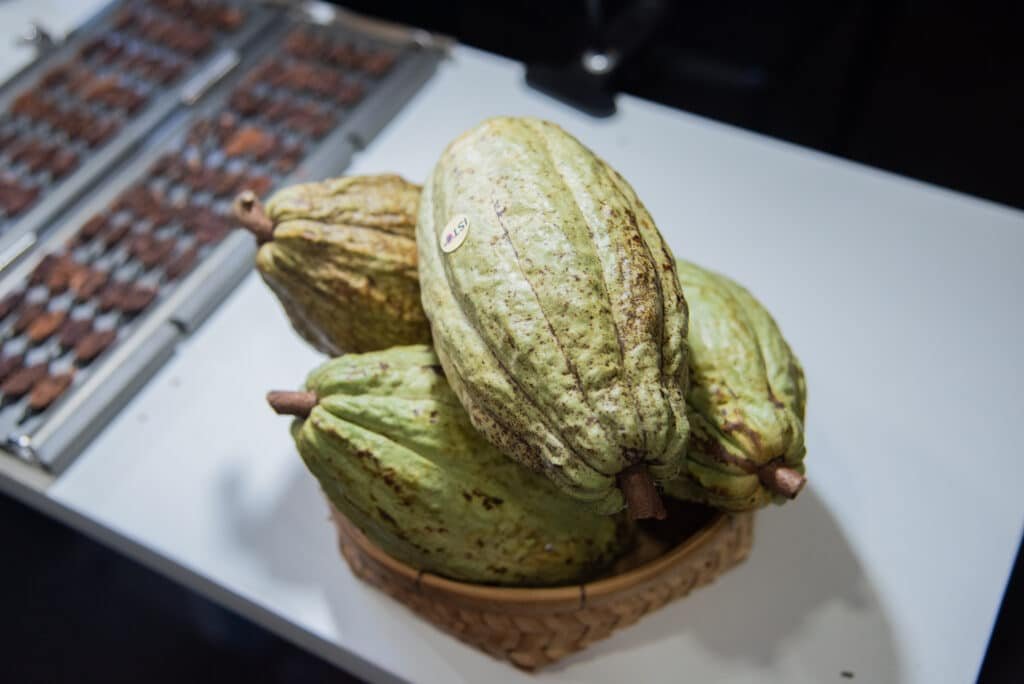
Scientists convert unsellable cocoa and husks into nutritional supplements that generate new income streams and strengthen farm resilience
Researchers at Chulalongkorn University have developed a cocoa-based livestock supplement that transforms damaged cocoa beans and discarded cocoa husks into premium animal feed ingredients, creating a new revenue stream for cocoa growers while helping livestock producers manage rising feed costs.
The innovation emerges at a time when climate volatility is placing increasing pressure on agricultural systems across Southeast Asia. Severe weather conditions have reportedly caused cocoa crop losses of as much as 80–90 per cent in some growing areas, leaving farmers with large volumes of low-grade or unsellable produce. Simultaneously, livestock producers have faced escalating feed expenses amid recurring droughts and supply disruptions.
Rather than allowing this material to go to waste, researchers have sought to integrate it back into the agricultural value chain through a circular economy approach.
The project, led by Asst. Prof. Dr. Tansiphorn Na Nan from Chulalongkorn University’s Faculty of Integrated Agriculture and the Innovation Center for Research and Development of Sustainable Cocoa Thailand (ISTC), has resulted in two commercial feed supplement formats: compressed mineral lick blocks designed for small-scale livestock operations and powdered feed additives suitable for larger commercial farms.
Both formulations can incorporate cocoa by-products at levels of up to 30 per cent of the final ingredient mix, creating a scalable pathway for waste utilisation while generating additional value from the cocoa supply chain.
From Agricultural Waste to Animal Performance
The scientific rationale behind the innovation lies in cocoa’s naturally occurring bioactive compounds.
Researchers found that substances such as flavonoids, polyphenols, tannins and theobromine deliver measurable benefits to animal health and productivity. Theobromine, a naturally occurring compound in cocoa, demonstrated potential to improve animal well-being, reduce inflammatory responses and enhance feed conversion efficiency.
Trials conducted in dairy cattle produced particularly notable results.
According to the research team, cattle receiving the supplement recorded a reduction of more than 70 per cent in somatic cell counts, a key indicator associated with mastitis and udder health. Milk quality also improved, with fat content increasing by as much as 15 per cent, potentially enhancing dairy farm profitability.
The impact extended beyond milk production.
Premium Beef Potential
In beef cattle, the supplement appeared to improve carcass quality and market value.
Researchers reported that animals traditionally sold as standard-grade beef showed significant improvements in meat characteristics after supplementation, with some achieving premium A3 and A4 quality grades. These higher-value classifications translated into substantially greater market prices, with certain animals reportedly commanding values exceeding 100,000 baht, compared with conventional market prices of 20,000–30,000 baht per head.
The findings suggest that nutritional interventions could play a growing role in helping livestock producers capture value in premium meat markets.
Climate Benefits Add to the Business Case
Beyond productivity gains, the research also points to potential environmental benefits.
Tannins present in cocoa were found to suppress methane-producing microorganisms within the rumen, reducing enteric methane emissions by up to 44 per cent during testing. By limiting energy losses associated with methane production, more energy becomes available for muscle growth and fat deposition, creating a dual benefit of improved livestock performance and lower greenhouse gas emissions.
The development is particularly significant as livestock production comes under increasing scrutiny for its contribution to agricultural emissions and climate change.
Expanding Beyond Cattle
Researchers are now exploring applications of cocoa-derived feed supplements across a broader range of production systems, including poultry, goat and aquaculture operations.
The initiative reflects a growing trend within agriculture toward extracting greater value from agricultural residues and by-products, transforming waste streams into commercially viable inputs.
For Thailand’s cocoa industry, which remains relatively small compared with global producers but is seeking higher-value opportunities, the innovation offers a compelling example of how research-driven circular economy solutions can create benefits across multiple agricultural sectors simultaneously.
As climate pressures intensify and sustainability becomes increasingly central to food production strategies, innovations that convert waste into productivity gains may become an increasingly important part of the future agricultural economy.
In the case of Chulalongkorn University’s cocoa project, a discarded by-product is being reimagined as a tool for improving farm profitability, reducing environmental impact and strengthening agricultural resilience—demonstrating how some of agriculture’s most promising solutions may already be hidden within its waste streams.
