
Deal guarantees 1.5 Million Metric Tons of Vietnamese rice through April 2027 amid rising geopolitical and climate risks
In a strategic move aimed at insulating the country from mounting geopolitical uncertainty and food supply volatility, the Philippines has secured a long-term rice trade mechanism with Vietnam that guarantees uninterrupted rice shipments through April 2027, reinforcing Manila’s broader effort to stabilize domestic food security amid an increasingly fragile global agricultural environment.
The agreement, reached during bilateral discussions between Philippine President Ferdinand R. Marcos Jr. and Vietnamese Prime Minister Lê Minh Hưng on the sidelines of the 48th ASEAN Summit in Cebu, marks one of the region’s most consequential food supply arrangements at a time when climate disruption, shipping instability, and geopolitical tensions continue to reshape agricultural trade flows across Asia.
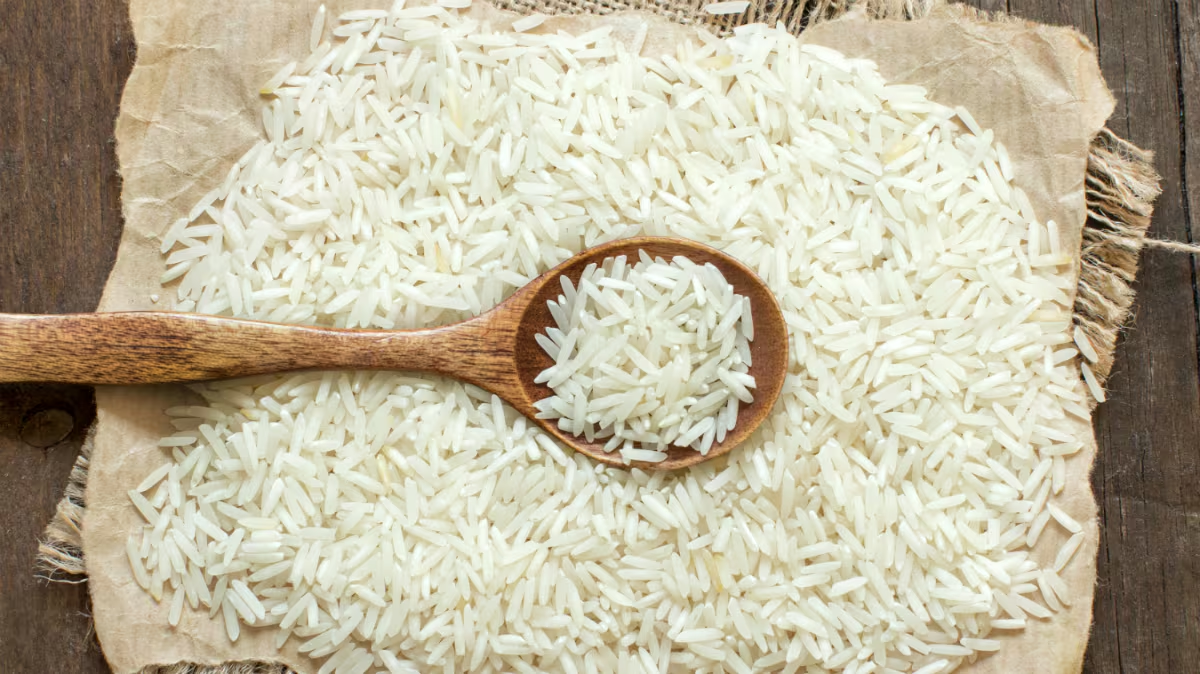
According to the Philippine Department of Agriculture, the arrangement ensures the continued delivery of approximately 1.5 million metric tons of Vietnamese Dai Thom 8 rice — widely known in regional markets as DT8 — until April next year, providing the Philippines with a critical supply buffer against external shocks and market dislocations.
Agriculture Secretary Francisco Tiu Laurel Jr. described the agreement as a vital safeguard amid rising uncertainty linked to Middle East tensions and broader global supply chain vulnerabilities.
“Securing import volumes until next April is crucial amid geopolitical uncertainties and climate risks,” Tiu Laurel said, emphasizing that the arrangement would help preserve supply continuity while supporting efforts to stabilize domestic retail prices.
The agreement arrives at a pivotal moment for Southeast Asia’s food security architecture. Rice remains not merely a staple commodity in the Philippines, but a politically sensitive economic pillar whose pricing and availability carry direct implications for inflation, household spending, and national stability.
Under the framework, the Philippines will purchase premium DT8 rice at approximately $ 450 per metric ton, while additional rice varieties are expected to be acquired at significantly lower rates, potentially near $ 390 per metric ton, according to the Department of Agriculture.
DT8 rice, prized in Philippine markets for its long grain profile, soft texture, and subtle aroma, has steadily expanded its consumer appeal in recent years as households increasingly gravitate toward higher-quality imported varieties.
Beyond the commercial dimensions of the agreement, officials framed the pact as part of a broader regional integration strategy intended to strengthen intra-ASEAN agricultural resilience.
“This deal builds on our push for ASEAN countries to trade more closely — it’s another step toward regional integration,” Tiu Laurel noted, positioning the arrangement as a model for deeper food cooperation across Southeast Asia.
Analysts suggest the agreement reflects a wider recalibration underway among Asian governments as food security re-emerges as a strategic national priority. The combined effects of climate volatility, export restrictions, commodity inflation, and geopolitical fragmentation have exposed vulnerabilities within global agricultural supply chains, prompting import-dependent nations to pursue more structured and predictable sourcing arrangements.
For the Philippines, one of the world’s largest rice importers, ensuring continuity of supply has become increasingly urgent following years of inflationary pressure tied to food prices and weather-related disruptions affecting domestic production.
The government stressed that despite the Vietnam agreement, Manila will continue diversifying procurement channels and maintaining alternative sourcing strategies to strengthen resilience against unforeseen regional disruptions.
At a deeper level, however, the pact also signals a shifting geopolitical reality in Asia’s agricultural economy: food diplomacy is becoming inseparable from economic security itself.
As nations confront intensifying competition for reliable agricultural supply chains, bilateral agreements such as the Philippines-Vietnam rice mechanism are evolving beyond simple trade arrangements into instruments of strategic stability — designed not only to secure grain flows, but to preserve political and economic equilibrium in an increasingly unpredictable world.
